


Page 213 - The Book of Caterpillars: A Life-Size Guide to Six Hundred Species From Around the World
P. 213
BUTTERFLY CATERPILLARS

                      FAMILY  Nymphalidae
                  DISTRIBUTION  Across Canada (except the far north), northern and western
                           United States, Europe, and northern Asia
                     HABITAT  Low to high-elevation grassy habitats, prairies, steppes, roadsides,
                           forest clearings, and subalpine meadows
                  HOST PLANTS  Grasses, including Poa spp., Festuca spp., Stipa spp.,
                           and Bromus spp.
                      NOTE  Caterpillar that blends in well on its host grasses
             CONSERVATION STATUS  Not evaluated, but common


                                                                                   ADULT WINGSPAN
                                                                                  1 ⁄  –1⅜ in (30–35 mm)


                                                                                  CATERPILLAR LENGTH
                                                                                   ⅞–1 in (23–25 mm)
            COENONYMPHA TULLIA
            OCHRE RINGLET                                                                        211

            (MÜLLER, 1764)


            The cream eggs of the Ochre or Common Ringlet are laid
            singly on grass stems or blades, and the caterpillars hatch after
            six days. The larvae are extremely well camou aged, with green,

            longitudinal stripes that blend perfectly with grasses. A small
            proportion of caterpillars in some populations are brown, which
            may occur as a result of drier conditions and frequently senescing

            grasses. The larvae develop through four or  ve instars. Most
            do not construct nests, but late summer caterpillars build loose
            silken shelters before dormancy in which they overwinter.


            There are four or five instars, and development from egg to
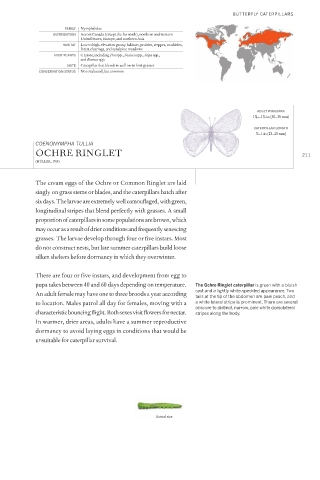
            pupa takes between 40 and 60 days depending on temperature.   The Ochre Ringlet caterpillar is green with a bluish
            An adult female may have one to three broods a year according   cast and a lightly white-speckled appearance. Two
                                                               tails at the tip of the abdomen are pale peach, and
            to location. Males patrol all day for females, moving with a   a white lateral stripe is prominent. There are several

            characteristic bouncing  ight. Both sexes visit  owers for nectar.   obscure to distinct, narrow, pale white dorsolateral

                                                               stripes along the body.
            In warmer, drier areas, adults have a summer reproductive
            dormancy to avoid laying eggs in conditions that would be
            unsuitable for caterpillar survival.


                                                   Actual size

