


Page 214 - The Book of Caterpillars: A Life-Size Guide to Six Hundred Species From Around the World
P. 214
BUTTERFLY CATERPILLARS

                                                     FAMILY  Nymphalidae
                                                 DISTRIBUTION  Mexico, Central America, most of the Caribbean, south to
                                                          Colombia and Ecuador west of the Andes; east of the Andes,
                                                          south from the Guianas and Venezuela to southeast Brazil
                                                    HABITAT  Humid and semi-humid forests, forest edges, and
                                                          regenerating habitat
                                                  HOST PLANTS  Cecropia spp.
                                                      NOTE  Striking caterpillars that are gregarious and found in leaf shelters
                                             CONSERVATION STATUS  Not evaluated, but unlikely to become endangered


            ADULT WINGSPAN
           2¾–3 in (70–75 mm)
           CATERPILLAR LENGTH

           1 ⁄  –1⅜ in (30–35 mm)

                                                                              COLOBURA DIRCE
                                                                   ZEBRA MOSAIC
    212
                                                                                   (LINNAEUS, 1758)


                                            When not feeding, young Zebra Mosaic caterpillars rest on
                                            frass chains protruding from the leaf margins, which provide
                                            them with a defense against marauding ants. For reasons that
                                            are not fully understood, ants seem unwilling to walk over the
                                            frass chains. As the larvae grow, they leave their frass chains
                                            and feed gregariously in groups of 5 to 20 caterpillars. When
                                            feeding, they usually bite through leaf veins and stems, helping
                                            to drain toxic plant compounds from the leaves and forming
                                            a loose shelter of drooping leaves around themselves. At the


                                            end of the  fth and  nal instar, larvae leave the group to pupate
                                            alone, either on or close to their host plant.

                                            Although the original spelling of the Zebra Mosaic’s Latin


                                            scienti c name was Papilio dirco, Linnaeus, who  rst described
                                            the species more than 250 years ago, misspelled it “dirce.” All
                                            subsequent authors followed suit until this incorrect spelling
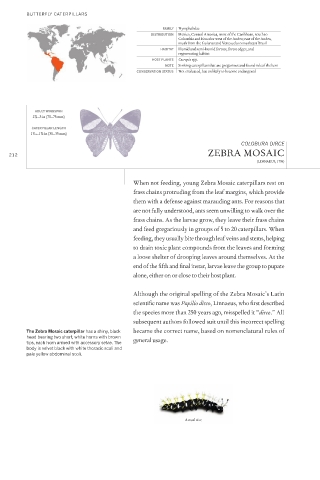
         The Zebra Mosaic caterpillar has a shiny, black   became the correct name, based on nomenclatural rules of
         head bearing two short, white horns with brown   general usage.
         tips, each horn armed with accessory setae. The
         body is velvet black with white thoracic scoli and
         pale yellow abdominal scoli.


                                                            Actual size

