


Page 215 - The Book of Caterpillars: A Life-Size Guide to Six Hundred Species From Around the World
P. 215
BUTTERFLY CATERPILLARS

                      FAMILY  Nymphalidae
                  DISTRIBUTION  Andean regions of Venezuela, Colombia, and Ecuador
                           (possibly Peru)
                     HABITAT  Cloud forests, forest edges, and landslides at mid to
                           upper elevations
                  HOST PLANTS  Bamboo (Chusquea spp.)
                      NOTE  Rarely encountered caterpillar that is extremely cryptic
                           on host plants
             CONSERVATION STATUS  Not evaluated, but unlikely to become endangered


                                                                                   ADULT WINGSPAN
                                                                                  2⅜–2¾ in (60–70 mm)
                                                                                  CATERPILLAR LENGTH
                                                                                  2⅛–2⅜ in (55–60 mm)
            CORADES CHELONIS
            CORADES CHELONIS                                                                     213

            HEWITSON, 1863


            Unlike other species of its genus, Corades chelonis deposits
            only one to two eggs at a time, and larvae feed solitarily. When
            mature, the caterpillars are almost indistinguishable from an
            aging leaf of their host plant. Their forward and rearward
            projections make their shape very similar to the long, slender
            bamboo leaves, and their brown and yellowish markings are
            a perfect match to the aging patterns seen on older bamboo
            leaves. Pupation occurs on the host plant stem, often close to
            new growth. The pupa resembles, in shape and color, freshly
            emerging leaves.


            Adults are rapid and active fliers, often descending to the
            ground to feed at urine or dung. They seem to be equally active
            on sunny and cloudy days, at least in eastern Ecuador. When

            ovipositing, females  y rapidly over areas of bamboo, dropping
            suddenly to land on a leaf and curling their abdomen under to
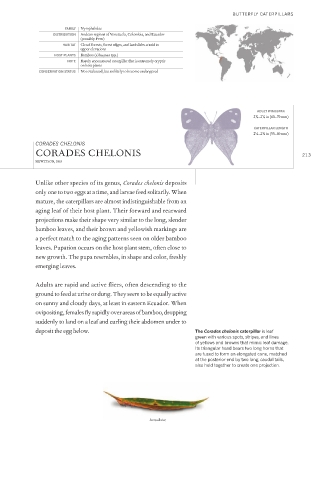
            deposit the egg below.                             The Corades chelonis caterpillar is leaf
                                                               green with various spots, stripes, and lines
                                                               of yellows and browns that mimic leaf damage.
                                                               Its triangular head bears two long horns that
                                                               are fused to form an elongated cone, matched
                                                               at the posterior end by two long, caudal tails,
                                                               also held together to create one projection.


                                                 Actual size

