


Page 216 - The Book of Caterpillars: A Life-Size Guide to Six Hundred Species From Around the World
P. 216
BUTTERFLY CATERPILLARS

                                                     FAMILY  Nymphalidae
                                                 DISTRIBUTION  The Himalayas, much of India through to western and southern
                                                          China and Vietnam; isolated subspecies in Chinese Taipei
                                                          and Okinawa, Japan
                                                    HABITAT  Primary and secondary forest, often near water
                                                  HOST PLANTS  Figs (Ficus spp.)
                                                      NOTE  Multi-horned caterpillar that resembles host plant new growth
                                             CONSERVATION STATUS  Not evaluated, but relatively common in its range


            ADULT WINGSPAN
           2⅛–2¾ in (55–70 mm)
           CATERPILLAR LENGTH
             1 ⁄   in (40 mm)
                                                                          CYRESTIS THYODAMAS
                                                                    COMMON MAP
    214
                                                                                  (BOISDUVAL, 1836)


                                            The eggs of the Common Map, also known as the Common
                                            Mapwing, are laid on new host plant shoots and take three days
                                            to hatch, the caterpillar forcing open a cap on the topside of
                                            the egg. The larvae are well camou aged as their impressive

                                            heads and body horns look remarkably like the new shoots of
                                            the  g trees they live on. The caterpillar feeds for 15 days before

                                            pupating on the host plant or adjacent vegetation. The chrysalis
                                            hangs unsupported by its tail and is dark brown with a high
                                            ridge along the backline. The head end is produced into a long,
                                            curved snout, giving the pupa an elongated shape. The pupal
                                            period lasts seven days.


                                            There are generally two generations annually between March
                                            and December. The wings of the Common Map are a stunning,
                                            marbled, cartographic pattern of  ne lines and colored patches


                                            on a white background, almost always opened wide and  at and
                                            rarely seen held upright.


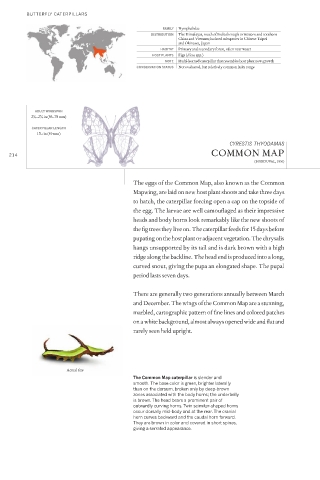
                      Actual size
                                            The Common Map caterpillar is slender and
                                            smooth. The base color is green, brighter laterally
                                            than on the dorsum, broken only by deep-brown
                                            zones associated with the body horns; the underbelly
                                            is brown. The head bears a prominent pair of
                                            outwardly curving horns. Twin scimitar-shaped horns
                                            occur dorsally mid-body and at the rear. The cranial
                                            horn curves backward and the caudal horn forward.
                                            They are brown in color and covered in short spines,
                                            giving a serrated appearance.

