


Page 217 - The Book of Caterpillars: A Life-Size Guide to Six Hundred Species From Around the World
P. 217
BUTTERFLY CATERPILLARS

                      FAMILY  Nymphalidae
                  DISTRIBUTION  Eastern slopes of the Andes in Ecuador
                     HABITAT  Mid-elevation cloud forests, especially in areas with heavy
                           bamboo undergrowth
                  HOST PLANTS  Dwarf Bamboo (Chusquea cf. scandens)
                      NOTE  Caterpillar that feeds gregariously when young and is
                           solitary later
             CONSERVATION STATUS  Not evaluated, but may have a very restricted geographic range


                                                                                   ADULT WINGSPAN
                                                                                  2⅛–2⅜ in (55–60 mm)
                                                                                  CATERPILLAR LENGTH
            DAEDALMA RUBROREDUCTA                                                 1 ⁄  –1⅜ in (30–35 mm)


            DAEDALMA
            RUBROREDUCTA                                                                         215
            PYRCZ & WILLMOTT, 2011


            Just after hatching, tiny Daedalma rubroreducta caterpillars
            huddle in a tightly packed group on the underside of a leaf. Later,
            prior to molt, they aggregate at the apex of the skeletonized

            food plant leaf, rearing back and regurgitating dark  uid when
            disturbed. As they grow older, they form lines along a narrow
            portion of a leaf, hanging in a vertical position under the larval
            weight. They later break into groups of two to  ve individuals,


            only dispersing as  nal instars.

            Discovered only recently, Daedalma rubroreducta may have
            a broader range than is currently known, possibly extending
            into the eastern Andes of Colombia and Peru. The butter ies,

            when seen, are usually found feeding at animal droppings or
            other rotting organic matter. Daedalma rubroreducta is the only
            member of the genus to have its full life history described.
            However, related species are also known to feed on montane
            bamboos, and similarly to have caterpillars that resemble sticks
            and pupae that look like dead leaves.


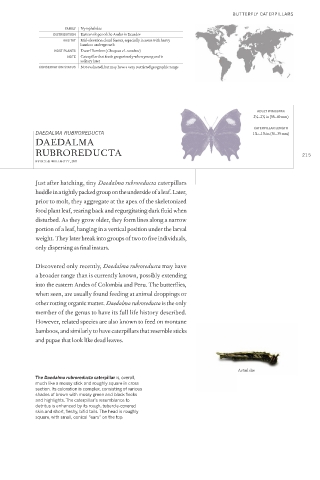
                                                                             Actual size
            The Daedalma rubroreducta caterpillar is, overall,
            much like a mossy stick and roughly square in cross
            section. Its coloration is complex, consisting of various
            shades of brown with mossy green and black   ecks
            and highlights. The caterpillar’s resemblance to
            detritus is enhanced by its rough, tubercle-covered
            skin and short,   eshy, bi  d tails. The head is roughly
            square, with small, conical “ears” on the top.

