


Page 253 - The Book of Caterpillars: A Life-Size Guide to Six Hundred Species From Around the World
P. 253
BUTTERFLY CATERPILLARS

                      FAMILY  Nymphalidae
                  DISTRIBUTION  Europe, across central Asia, southern Siberia, Mongolia,
                           northeast China, Korea, and Japan
                     HABITAT  Various, including pine woodlands, coppiced woodlands, alpine
                           meadows, grasslands, wetlands, and fens
                  HOST PLANTS  Mostly Valeriana spp.; also cow wheat (Melampyrum spp.)
                      NOTE  Spiny caterpillar that overwinters within curled-up dead leaves
             CONSERVATION STATUS  Not evaluated, but locally threatened


                                                                                   ADULT WINGSPAN
                                                                                  1¼–1⅝ in (32–42 mm)
                                                                                  CATERPILLAR LENGTH
                                                                                      ⁄   in (18 mm)
            MELITAEA DIAMINA
            FALSE HEATH FRITILLARY                                                               251

            (LANG, 1789)


            False Heath Fritillary caterpillars hatch from pale yellow eggs
            laid by the female in batches of about 100 on the underside of
            leaves of the host plant. The larvae are gregarious, living and
            feeding together in a communal web spun from silk threads.
            On cool but sunny days they may be seen basking on the surface.   Actual size
            The caterpillars overwinter inside dead, curled leaves beneath
            the host plant and become active again from April. As they
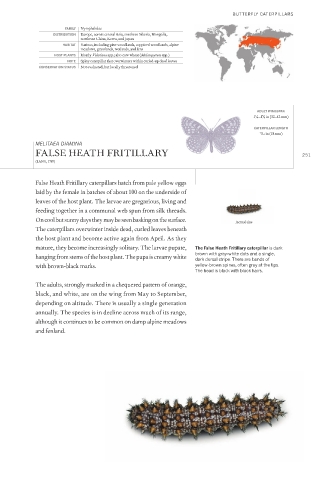
            mature, they become increasingly solitary. The larvae pupate,   The False Heath Fritillary caterpillar is dark
            hanging from stems of the host plant. The pupa is creamy white   brown with gray-white dots and a single,
                                                               dark dorsal stripe. There are bands of
            with brown-black marks.                            yellow-brown spines, often gray at the tips.
                                                               The head is black with black hairs.

            The adults, strongly marked in a chequered pattern of orange,
            black, and white, are on the wing from May to September,
            depending on altitude. There is usually a single generation
            annually. The species is in decline across much of its range,
            although it continues to be common on damp alpine meadows
            and fenland.

