


Page 254 - The Book of Caterpillars: A Life-Size Guide to Six Hundred Species From Around the World
P. 254
BUTTERFLY CATERPILLARS

                                                     FAMILY  Nymphalidae
                                                 DISTRIBUTION  Eastern Colombia to southeast Ecuador, but possibly
                                                          farther south
                                                    HABITAT  Intact tracts of subtropical cloud forests, forest edges, and
                                                          light gaps, at 5,600–7,200 ft (1,700–2,200 m) elevation
                                                  HOST PLANTS  Nectandra spp. and Ocotea spp.
                                                      NOTE  Caterpillar that hides inside a rolled-up leaf when mature
                                             CONSERVATION STATUS  Not evaluated, but not considered threatened


            ADULT WINGSPAN
           2  ⁄  –3 in (68–75 mm)
           CATERPILLAR LENGTH
           2⅛–2 ⁄   in (55–65 mm)
                                                                              MEMPHIS LORNA
                                                             LORNA LEAFWING
    252
                                                                                     (DRUCE, 1877)


                                            From observations in northeastern Ecuador, the rare, brownish,
                                            tubular-shaped, green-speckled Lorna Leafwing caterpillar
                                            looks remarkably like a moldy, mossy twig. As first to third
                                            instars, the larvae rest on chains of frass projecting from the
                                            edge of host plant leaves, then create a tube-shaped shelter out
                                            of a rolled host plant leaf during the fourth and  fth instars. The

                                            spiky nature of the caterpillar’s head, in conjunction with its
                                            unusual thickness, create a protective “plug” to  ll the entrance

                                            to the shelter, preventing predator access to the larva’s more
                                            vulnerable parts.

                                            Memphis lorna is confined to a narrow elevational range in
                                            eastern Colombia and Ecuador, but may also occur east of the
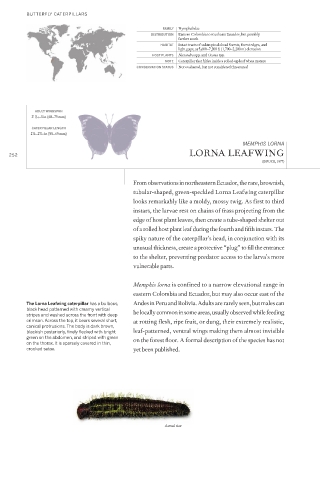
         The Lorna Leafwing caterpillar has a bulbous,   Andes in Peru and Bolivia. Adults are rarely seen, but males can
         black head patterned with creamy vertical   be locally common in some areas, usually observed while feeding
         stripes and washed across the front with deep
         crimson. Across the top, it bears several short,   at rotting flesh, ripe fruit, or dung, their extremely realistic,
         conical protrusions. The body is dark brown,
         blackish posteriorly,   nely   ecked with bright   leaf-patterned, ventral wings making them almost invisible
         green on the abdomen, and striped with green   on the forest  oor. A formal description of the species has not

         on the thorax. It is sparsely covered in thin,
         crooked setae.                     yet been published.


                                                      Actual size

