


Page 255 - The Book of Caterpillars: A Life-Size Guide to Six Hundred Species From Around the World
P. 255
BUTTERFLY CATERPILLARS

                      FAMILY  Nymphalidae
                  DISTRIBUTION  South and Southeast Asia
                     HABITAT  Glades and clearings in heavily forested regions with
                           heavy rainfall
                  HOST PLANTS  Rubiaceae, including Cinchona spp. and Wendlandia spp.;
                           also Capparaceae

                      NOTE  Camou aged caterpillar that uses its frass to deter predators
             CONSERVATION STATUS  Not evaluated, but most common of its genus


                                                                                   ADULT WINGSPAN
                                                                                  2⅜–3 in (60–75 mm)
                                                                                  CATERPILLAR LENGTH
                                                                                  ¾–⅞ in (20–22 mm)
            MODUZA PROCRIS
            COMMANDER                                                                            253

            (CRAMER, 1777)


            Commander larvae emerge from spiny, green eggs—resembling
            tiny sea urchins—which the butter y lays on the underside of

            leaves near the shoot tip up to four days earlier. The fast-growing
            and bizarre-looking caterpillar has an unusual defensive strategy.
            It partially consumes a leaf, and then combines its excreted frass
            with bits of chewed leaf to create a long chain held together with   Actual size
            silk thread. The chain, together with scattered frass, which is
            believed to contain toxins, acts as a barrier to deter ants and other
            predatory insects from reaching the caterpillar while it rests.


            Mature caterpillars may move some distance from the host plant
            to pupate on the ground in the leaf litter. The brown pupa is
            camou aged with lines and markings to resemble a rolled-up

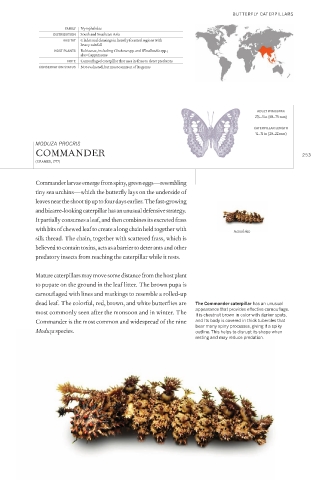
            dead leaf. The colorful, red, brown, and white butter  ies are   The Commander caterpillar has an unusual
            most commonly seen after the monsoon and in winter. The   appearance that provides e  ective camou  age.
                                                               It is chestnut brown in color with darker spots,
            Commander is the most common and widespread of the nine   and Its body is covered in thick tubercles that
            Moduza species.                                    bear many spiny processes, giving it a spiky
                                                               outline. This helps to disrupt its shape when
                                                               resting and may reduce predation.

