


Page 256 - The Book of Caterpillars: A Life-Size Guide to Six Hundred Species From Around the World
P. 256
BUTTERFLY CATERPILLARS

                                                     FAMILY  Nymphalidae
                                                 DISTRIBUTION  Central America and northern part of South America
                                                    HABITAT  Tropical rain forests
                                                  HOST PLANTS  Leguminosae, including Arachis hypogaea, Lonchocarpus spp.,
                                                          Inga spp., Medicago sativa, and Pithecellobium spp.; also at least
                                                          one member of Bignoniaceae, Paragonia pyramidata
                                                      NOTE  Tropical caterpillar that apparently relies mostly on crypsis
                                                          for defense
                                             CONSERVATION STATUS  Not evaluated, but common, although, like all tropical forest

                                                          species, a ected by habitat loss


            ADULT WINGSPAN
           4–6 in (100–150 mm)
           CATERPILLAR LENGTH
           4–5 in (100–130 mm)
                                                                             MORPHO PELEIDES
                                                                    BLUE MORPHO
    254
                                                                                     KOLLAR, 1850


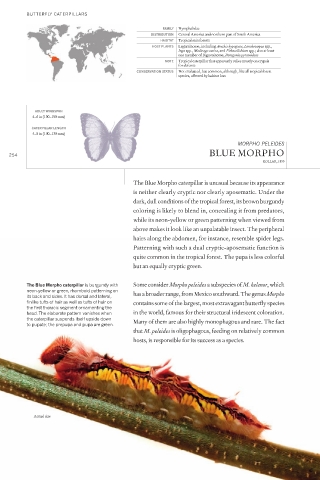
                                            The Blue Morpho caterpillar is unusual because its appearance
                                            is neither clearly cryptic nor clearly aposematic. Under the
                                            dark, dull conditions of the tropical forest, its brown burgundy
                                            coloring is likely to blend in, concealing it from predators,
                                            while its neon-yellow or green patterning when viewed from
                                            above makes it look like an unpalatable insect. The peripheral
                                            hairs along the abdomen, for instance, resemble spider legs.
                                            Patterning with such a dual cryptic-aposematic function is
                                            quite common in the tropical forest. The pupa is less colorful
                                            but an equally cryptic green.


          The Blue Morpho caterpillar is burgundy with   Some consider Morpho peleides a subspecies of M. helenor, which
          neon-yellow or green, rhomboid patterning on   has a broader range, from Mexico southward. The genus Morpho
          its back and sides. It has dorsal and lateral,

            nlike tufts of hair as well as tufts of hair on   contains some of the largest, most extravagant butter y species
          the   rst thoracic segment ornamenting the
          head. The elaborate pattern vanishes when   in the world, famous for their structural iridescent coloration.
          the caterpillar suspends itself upside down   Many of them are also highly monophagous and rare. The fact
          to pupate; the prepupa and pupa are green.
                                            that M. peleides is oligophagous, feeding on relatively common
                                            hosts, is responsible for its success as a species.


            Actual size

