


Page 257 - The Book of Caterpillars: A Life-Size Guide to Six Hundred Species From Around the World
P. 257
BUTTERFLY CATERPILLARS

                      FAMILY  Nymphalidae
                  DISTRIBUTION  From the coastal Andean range of Venezuela, south to Colombia
                           and northern Ecuador on both Andean slopes
                     HABITAT  Cloud forests and bamboo thickets at middle and upper elevations
                  HOST PLANTS  Bamboo (Chusquea spp.)
                      NOTE  Distinctive caterpillar, but rarely seen
             CONSERVATION STATUS  Not evaluated, but unlikely to be endangered


                                                                                   ADULT WINGSPAN
                                                                                  2 ⁄  –2¾ in (65–70 mm)
                                                                                  CATERPILLAR LENGTH
                                                                                  1⅛–1¼ in (28–32 mm)
            MYGONA IRMINA
            MYGONA IRMINA                                                                        255

            (DOUBLEDAY, [1849])


            Mygona irmina caterpillars hatch from eggs laid singly on the
            underside of mature bamboo leaves. Initially, they rest near
            the tip of mature leaves, feeding in a way that leaves one margin
            of the leaf apex intact. Against this thinned portion of the leaf,
            they are very cryptic. During the middle stage of development,
            larvae rest on the dorsal surface of leaves, often traveling to
            adjacent leaves to feed. Immediately after molting to the  nal

            instar, the caterpillars are various shades of brown, green, and
            pale blue dorsally and dorsolaterally, with shades of white
            and pink spiracularly to ventrolaterally. Within a day, they
            become darker overall, turning to shades of brown.
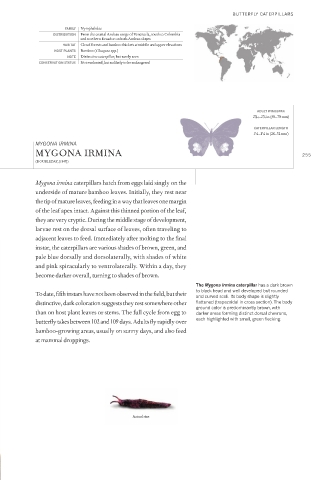
                                                                The Mygona irmina caterpillar has a dark brown


            To date,  fth instars have not been observed in the  eld, but their   to black head and well developed but rounded
                                                                and curved scoli. Its body shape is slightly
            distinctive, dark coloration suggests they rest somewhere other     attened (trapezoidal in cross section). The body
            than on host plant leaves or stems. The full cycle from egg to   ground color is predominantly brown, with
                                                                darker areas forming distinct dorsal chevrons,
            butter y takes between 102 and 109 days. Adults  y rapidly over   each highlighted with small, green   ecking.


            bamboo-growing areas, usually on sunny days, and also feed
            at mammal droppings.


                                           Actual size

