


Page 258 - The Book of Caterpillars: A Life-Size Guide to Six Hundred Species From Around the World
P. 258
BUTTERFLY CATERPILLARS

                                                     FAMILY  Nymphalidae
                                                 DISTRIBUTION  Mainland New Guinea, northeastern and eastern Australia
                                                    HABITAT  Mainly lowland rain forest along streams, but occurs up to
                                                          2,625 ft (800 m) elevation
                                                  HOST PLANTS  Stinging trees in the Urticaceae family, such as Dendrocnide spp.,
                                                          and Native Mulberry (Pipturus argenteus)
                                                      NOTE  Caterpillar that moves and feeds gregariously
                                             CONSERVATION STATUS  Not evaluated, but can be locally common


            ADULT WINGSPAN
           2–2¼ in (50–57 mm)
           CATERPILLAR LENGTH
           1 ⁄  –1¾ in (40–45 mm)
                                                                             MYNES GEOFFROYI
                                                                 JEZEBEL NYMPH
    256
                                                                             (GUÉRIN-MÉNEVILLE, [1830])


                                            Jezebel Nymph caterpillars hatch in clusters of up to 50
                                            individuals. They are initially orange with black hairs, well

                                            camou aged and gregarious, staying in clusters while feeding on
                                            the underside of leaves. They move en masse to new leaves when
                                            they have devoured the entire leaf. The larval stage lasts six to
                                            seven weeks in the cooler southern locations, and breeding can
                                            occur throughout the year, with several generations completed.


                                            The caterpillars pupate together or close by, often with ten or
                                            more under a single leaf, suspended head down and attached
                                            to a silken pad by the cremaster. The pupae thrash wildly for
                                            several seconds if disturbed. Butter ies from the same cohort


                                            all emerge within a day. Male butter ies are very territorial and
                                            have corridors that they patrol, chasing any other butter  ies
                                            entering their territory. The genus Mynes contains 12 species,
                                            which occur only in Australia, New Guinea, or Indonesia.


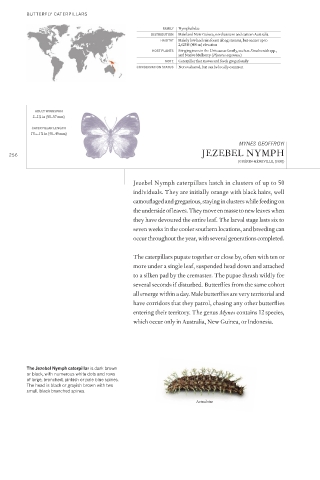
          The Jezebel Nymph caterpillar is dark brown
          or black, with numerous white dots and rows
          of large, branched, pinkish or pale blue spines.
          The head is black or grayish brown with two
          small, black branched spines.
                                                                Actual size

