


Page 259 - The Book of Caterpillars: A Life-Size Guide to Six Hundred Species From Around the World
P. 259
BUTTERFLY CATERPILLARS

                      FAMILY  Nymphalidae
                  DISTRIBUTION  Northwest Himalayas, northern India, southern China, Chinese
                           Taipei, Myanmar, Thailand, Malay Peninsula, and Sumatra
                     HABITAT  Subtropical and tropical evergreen forests
                  HOST PLANTS  Hall Crab Apple (Malus halliana) and Loquat (Eriobotrya japonica)
                      NOTE  Trapeze artist of the caterpillar world
             CONSERVATION STATUS  Not evaluated, but occurs in localized colonies so prone to threats


                                                                                   ADULT WINGSPAN
                                                                                  2⅛–2 ⁄   in (55–65 mm)
                                                                                  CATERPILLAR LENGTH
                                                                                    1 ⁄   in (30 mm)
            NEPTIS SANKARA
            BROAD-BANDED SAILER                                                                  257

            (KOLLAR, 1844)


            Like many nymphalid caterpillars, the Broad-banded Sailer
            incorporates frass chains and perches during its development.
            By creating a safe place on the food plant and building barriers of
            silk and frass, otherwise defenseless larvae can isolate themselves
            from predators and accidents. The species persists with the
            strategy into later instars by “trapezing.” Having stripped
            the leaf down to the midrib, the caterpillar lines it with silk   Actual size
            and leaf fragments, then spends much of the day hanging
            there, resembling debris. It migrates to other leaves to feed and
            pupates on foliage within a curved chrysalis. There are two
            generations annually.


            Typical of its genus, the Broad-banded Sailer butterfly is
            disruptively marked in black and white on its topside with
            cryptic brown-and-white patterns on the underside. This
            species and fellow “sailers” of Neptis are named for the way the
            butter ies rotate between perches in a very similar gliding or

            sailing fashion. Neptis larvae share the broad, horned head and
             eshy thoracic tubercles of N. sankara, although each species has

            its own variations. Populations of the Broad-banded Sailer are
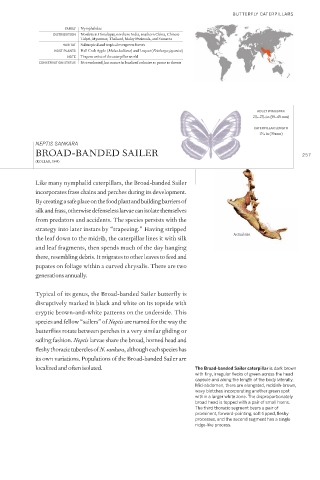
            localized and often isolated.                      The Broad-banded Sailer caterpillar is dark brown
                                                               with tiny, irregular   ecks of green across the head
                                                               capsule and along the length of the body laterally.
                                                               Mid-abdomen, there are elongated, reddish-brown,
                                                               wavy blotches incorporating another green spot
                                                               within a larger white zone. The disproportionately
                                                               broad head is topped with a pair of small horns.
                                                               The third thoracic segment bears a pair of
                                                               prominent, forward-pointing, soft-tipped,   eshy
                                                               processes, and the second segment has a single
                                                               ridge-like process.

