


Page 391 - The Book of Caterpillars: A Life-Size Guide to Six Hundred Species From Around the World
P. 391
MOTH CATERPILLARS

                      FAMILY  Saturniidae
                    TRIBUTION
                  DISTRIBUTION
                  DISTRIBUTION  Eastern central Peru
                  DIS
                     HABITAT
                     HABIT A T  Mid-elevation cloud forests
                     HABITAT
                  HOS
                  HOST PLANTS
                  HOST PLANTS S  Unknown, probably Lauraceae
                    T PLANT
                      NOTE
                      NOTE  Giant silkmoth species with ancient South American origins
                      NO
                        TE
                       A
                       TUS
                   TION S
                      T
                  A
             CONSERVATION STATUS
             CONSERVATION STATUS  Not evaluated
             CONSERV
                                                                                   ADULT WINGSPAN
                                                                                  3½–4⅛ in (90–105 mm)
                                                                                  CATERPILLAR LENGTH
                                                                                    3⅛ in (80 mm)
            COPAXA BELLA
            COPAXA BELLA                                                                         389
            WOLFE, NAUMANN, BROSCH, WENCZEL & NAESSIG, 2005
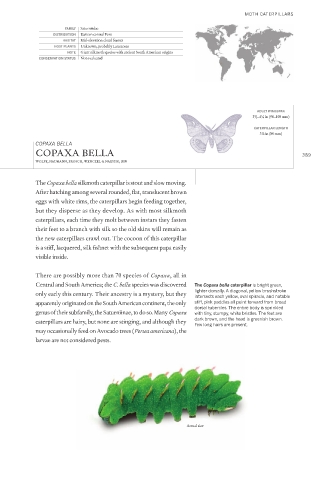
            The Copaxa bella silkmoth caterpillar is stout and slow moving.
            After hatching among several rounded,  at, translucent brown

            eggs with white rims, the caterpillars begin feeding together,
            but they disperse as they develop. As with most silkmoth
            caterpillars, each time they molt between instars they fasten
            their feet to a branch with silk so the old skins will remain as
            the new caterpillars crawl out. The cocoon of this caterpillar


            is a sti , lacquered, silk  shnet with the subsequent pupa easily
            visible inside.

            There are possibly more than 70 species of Copaxa, all in
            Central and South America; the C. bella species was discovered   The Copaxa bella caterpillar is bright green,
            only early this century. Their ancestry is a mystery, but they   lighter dorsally. A diagonal, yellow brushstroke
                                                               intersects each yellow, oval spiracle, and notable
            apparently originated on the South American continent, the only   sti  , pink paddles all point forward from broad
            genus of their subfamily, the Saturniinae, to do so. Many Copaxa   dorsal tubercles. The entire body is sprinkled
                                                               with tiny, stumpy, white bristles. The feet are
            caterpillars are hairy, but none are stinging, and although they   dark brown, and the head is greenish brown.
                                                               Few long hairs are present.
            may occasionally feed on Avocado trees (Persea americana), the
            larvae are not considered pests.


                                                             Actual size

