


Page 392 - The Book of Caterpillars: A Life-Size Guide to Six Hundred Species From Around the World
P. 392
MOTH CATERPILLARS

                                                     FAMILY  Saturniidae
                                                 DISTRIBUTION  Southern Mexico, south to central eastern Peru, northeast Bolivia,
                                                          and southern Brazil
                                                    HABITAT  Tropical forests
                                                  HOST PLANTS  Trees of the Sapotaceae family
                                                      NOTE  Reclusive caterpillar that feeds on “chewing gum” trees
                                             CONSERVATION STATUS  Not evaluated


            ADULT WINGSPAN
           3½–4½ in (89–114 mm)
           CATERPILLAR LENGTH
             3⅛ in (80 mm)
                                                                        COPIOPTERYX SEMIRAMIS
                                                 COPIOPTERYX SEMIRAMIS
    390
                                                                                    (CRAMER, 1775)


                                            The Copiopteryx semiramis silkmoth caterpillar hatches among

                                            several transparent eggs. At  rst it is yellow with black dorsal
                                            bands and black, stiff tubercles, but in subsequent stages it
                                            becomes green and mostly smooth. Reared caterpillars are not
                                            social and develop through six instars, feeding on Manilkara
                                            chicle, the sap from which the original chewing gum was made.
                                            The mature caterpillar burrows into the ground to pupate,
                                            and the adult may emerge in about six weeks or many months,
                                            depending on the day length when the caterpillar pupated.


                                            There are five species of Copiopteryx in the Arsenurinae
                                            subfamily, all with long-tailed adults and similar caterpillars,
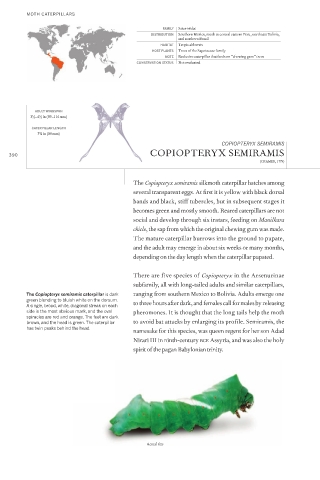
         The Copiopteryx semiramis caterpillar is dark   ranging from southern Mexico to Bolivia. Adults emerge one
         green blending to bluish white on the dorsum.   to three hours after dark, and females call for males by releasing
         A single, broad, white, diagonal streak on each
         side is the most obvious mark, and the oval   pheromones. It is thought that the long tails help the moth
         spiracles are red and orange. The feet are dark
         brown, and the head is green. The caterpillar   to avoid bat attacks by enlarging its profile. Semiramis, the
         has twin peaks behind the head.    namesake for this species, was queen regent for her son Adad
                                            Nirari III in ninth-century
 Assyria, and was also the holy
                                            spirit of the pagan Babylonian trinity.


                                                Actual size

