


Page 393 - The Book of Caterpillars: A Life-Size Guide to Six Hundred Species From Around the World
P. 393
MOTH CATERPILLARS

                      FAMILY  Saturniidae
                  DISTRIBUTION  New Guinea, northern Australia
                     HABITAT  Tropical rain forests
                  HOST PLANTS  Variety of rain forest trees, including Bleeding Heart
                           (Homalanthus populifolius), Dysoxylum spp., and
                           Glochidion spp.
                      NOTE  Fleshy, blue-green caterpillar that has eyespots to
                           confuse predators
             CONSERVATION STATUS  Not evaluated, but not threatened


                                                                                   ADULT WINGSPAN
                                                                                  Up to 10½ in (270 mm)
                                                                                  CATERPILLAR LENGTH
                                                                                    4 in (100 mm)
            COSCINOCERA HERCULES
            HERCULES MOTH                                                                        391

            (MISKIN, 1876)


            Hercules Moth caterpillars emerge from rusty-colored eggs,
            laid singly or in small groups on the leaves of host plants. The
            female moth lays up to 400 eggs that take about two weeks to
            hatch. The young caterpillars are mostly white and covered in
            small spines, but become blue in the later stages. The larvae
            are very large, with a voracious appetite to match. They eat
            a range of rain forest food plants, especially the leaves of the
            Bleeding Heart tree.


            After three months, the mature caterpillars crawl to the ground
            to pupate, spinning a brown-colored cocoon wrapped in a leaf

            for camou age. The emerging moths, named for their size after
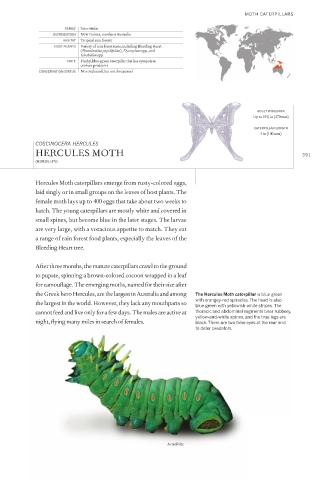
            the Greek hero Hercules, are the largest in Australia and among   The Hercules Moth caterpillar is blue green
            the largest in the world. However, they lack any mouthparts so   with orangey-red spiracles. The head is also
                                                               blue green with yellowish-white stripes. The
            cannot feed and live only for a few days. The males are active at   thoracic and abdominal segments bear rubbery,
            night,  ying many miles in search of females.      yellow-and-white spines, and the true legs are

                                                               black. There are two false eyes at the rear end
                                                               to deter predators.


                                                      Actual size

