


Page 394 - The Book of Caterpillars: A Life-Size Guide to Six Hundred Species From Around the World
P. 394
MOTH CATERPILLARS

                                                     FAMILY  Saturniidae
                                                 DISTRIBUTION  Both sides of the Andes, from Venezuela to northern Peru
                                                          and Bolivia
                                                    HABITAT  Mountain forests
                                                  HOST PLANTS  Unknown in the wild; in captivity has fed on Laurel Sumac
                                                          (Malosma laurina)
                                                      NOTE  Nervous giant silkmoth caterpillar that is seldom still
                                             CONSERVATION STATUS  Not evaluated


            ADULT WINGSPAN
           3	   –5 in (78–129 mm)
           CATERPILLAR LENGTH
             2¾ in (70 mm)
                                                                         DIRPHIA SOMNICULOSA
                                                    DIRPHIA SOMNICULOSA
    392
                                                                                    (CRAMER, 1777)


                                            The Dirphia somniculosa silkmoth caterpillar is extremely
                                            social. The larvae hatch in large numbers from white eggs 60
                                            days after laying and remain close together during most of their
                                            development. They are black in all stages and in the laboratory
                                            have fed voraciously on Laurel Sumac. They grow to a large
                                            size and seem somewhat agitated, moving almost constantly.
                                            At the end of the final instar, the caterpillars descend to the

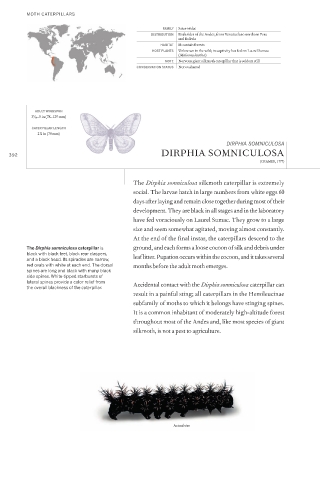
          The Dirphia somniculosa caterpillar is   ground, and each forms a loose cocoon of silk and debris under
          black with black feet, black rear claspers,   leaf litter. Pupation occurs within the cocoon, and it takes several
          and a black head. Its spiracles are narrow,
          red ovals with white at each end. The dorsal   months before the adult moth emerges.
          spines are long and black with many black
          side spines. White-tipped starbursts of
          lateral spines provide a color relief from   Accidental contact with the Dirphia somniculosa caterpillar can
          the overall blackness of the caterpillar.
                                            result in a painful sting; all caterpillars in the Hemileucinae
                                            subfamily of moths to which it belongs have stinging spines.
                                            It is a common inhabitant of moderately high-altitude forest
                                            throughout most of the Andes and, like most species of giant
                                            silkmoth, is not a pest to agriculture.


                                                        Actual size

