


Page 395 - The Book of Caterpillars: A Life-Size Guide to Six Hundred Species From Around the World
P. 395
MOTH CATERPILLARS

                      FAMILY  Saturniidae
                  DISTRIBUTION  Only known from two small areas in Guerrero (Mexico) and
                           Zacapa (Guatemala)
                     HABITAT  Mountainous tropical forests
                  HOST PLANTS  Unknown in the wild; in captivity has fed on oak (Quercus spp.)
                      NOTE  Giant silkmoth species that has an intriguing geographical range
             CONSERVATION STATUS  Not evaluated


                                                                                   ADULT WINGSPAN
                                                                                 2    –3		    in (59–93 mm)
                                                                                  CATERPILLAR LENGTH
                                                                                    2⅜ in (60 mm)
            DIRPHIOPSIS WOLFEI
            DIRPHIOPSIS WOLFEI                                                                   393

            LEMAIRE, 1992


            The Dirphiopsis wolfei silkmoth caterpillar hatches among tightly
            grouped, yellow eggs and soon sets o , following pheromone-

            laced web trails, to join other siblings that are searching for an
            acceptable feeding spot. It is initially yellow with a black head
            and black spines. By the fourth instar the caterpillar is reddish
            brown with white stripes and blue and reddish spines, and in the
             nal  fth and sixth instars it is mostly green. Pupation occurs on


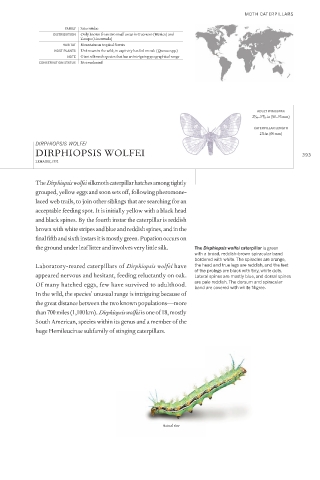
            the ground under leaf litter and involves very little silk.  The Dirphiopsis wolfei caterpillar is green
                                                               with a broad, reddish-brown spiracular band
                                                               bordered with white. The spiracles are orange,
            Laboratory-reared caterpillars of Dirphiopsis wolfei have   the head and true legs are reddish, and the feet
            appeared nervous and hesitant, feeding reluctantly on oak.   of the prolegs are black with tiny, white dots.
                                                               Lateral spines are mostly blue, and dorsal spines
            Of many hatched eggs, few have survived to adulthood.   are pale reddish. The dorsum and spiracular
                                                               band are covered with white   ligree.
            In the wild, the species’ unusual range is intriguing because of
            the great distance between the two known populations—more
            than 700 miles (1,100 km). Dirphiopsis wolfei is one of 18, mostly
            South American, species within its genus and a member of the
            huge Hemileucinae subfamily of stinging caterpillars.


                                                     Actual size

