


Page 396 - The Book of Caterpillars: A Life-Size Guide to Six Hundred Species From Around the World
P. 396
MOTH CATERPILLARS

                                                     FAMILY  Saturniidae
                                                 DISTRIBUTION  Guiano-Amazonian region, from Venezuela and Colombia
                                                          to Bolivia
                                                    HABITAT  Tropical forests
                                                  HOST PLANTS  Unknown in the wild; in captivity has fed on Laurel Sumac
                                                          (Malosma laurina)
                                                      NOTE  Giant silkmoth caterpillar that has an unexpected sting
                                             CONSERVATION STATUS  Not evaluated


            ADULT WINGSPAN
          3    –5	     in (88–149 mm)
           CATERPILLAR LENGTH
             3¾ in (95 mm)
                                                                               EACLES BARNESI
                                                                 EACLES BARNESI
    394
                                                                                     SCHAUS, 1905


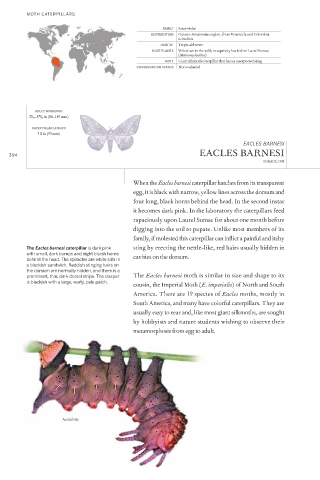
                                            When the Eacles barnesi caterpillar hatches from its transparent
                                            egg, it is black with narrow, yellow lines across the dorsum and
                                            four long, black horns behind the head. In the second instar
                                            it becomes dark pink. In the laboratory the caterpillars feed
                                            rapaciously upon Laurel Sumac for about one month before
                                            digging into the soil to pupate. Unlike most members of its
                                            family, if molested this caterpillar can in ict a painful and itchy

          The Eacles barnesi caterpillar is dark pink   sting by erecting the nettle-like, red hairs usually hidden in
          with small, dark bumps and eight bluish horns   cavities on the dorsum.
          behind the head. The spiracles are white slits in
          a blackish sandwich. Reddish stinging hairs on
          the dorsum are normally hidden, and there is a
          prominent, thin, dark dorsal stripe. The clasper   The Eacles barnesi moth is similar in size and shape to its
          is blackish with a large, warty, pale patch.  cousin, the Imperial Moth (E. imperialis) of North and South
                                            America. There are 19 species of Eacles moths, mostly in
                                            South America, and many have colorful caterpillars. They are
                                            usually easy to rear and, like most giant silkmoths, are sought
                                            by hobbyists and nature students wishing to observe their
                                            metamorphosis from egg to adult.


                     Actual size

