


Page 397 - The Book of Caterpillars: A Life-Size Guide to Six Hundred Species From Around the World
P. 397
MOTH CATERPILLARS

                      FAMILY  Saturniidae
                  DISTRIBUTION  From Canada south to at least northern Costa Rica, and west to
                           the Rocky Mountains
                     HABITAT  Deciduous and evergreen forests

                  HOST PLANTS  American Sweetgum (Liquidambar styraci uar), oak
                           (Quercus spp.), maple (Acer spp.), sassafras (Sassafras spp.),
                           and pine (Pinus spp.)

                      NOTE  Caterpillar that comes in two quite di erent color forms
             CONSERVATION STATUS  Not evaluated, but common, though experiencing decline
                           in northeastern United States


                                                                                   ADULT WINGSPAN
                                                                                  3⅛–6⅞ in (80–174 mm)
                                                                                  CATERPILLAR LENGTH
                                                                                   3–4 in (76–100 mm)
            EACLES IMPERIALIS
            IMPERIAL MOTH                                                                        395

            (DRURY, 1773)


            Imperial Moth eggs are laid in small groups of two to  ve, and

            the caterpillars are solitary. Initially orange with black horizontal

            stripes and long, black  laments, they later turn brown with
            an orange head, still retaining the filaments. These flexible,
            though spiny, projections protect the caterpillar from being
            swallowed by a predator and probably contribute to crypsis,
            by making the larva look more like a twig. In the last instar the
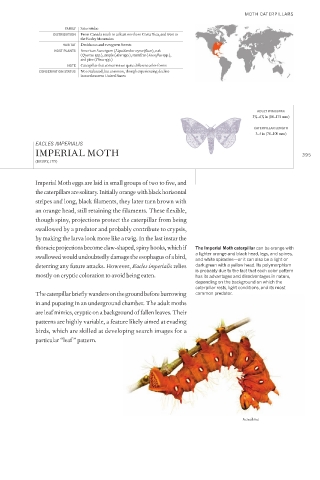
            thoracic projections become claw-shaped, spiny hooks, which if   The Imperial Moth caterpillar can be orange with
            swallowed would undoubtedly damage the esophagus of a bird,   a lighter orange and black head, legs, and spines,
                                                               and white spiracles—or it can also be a light or
            deterring any future attacks. However, Eacles imperialis relies   dark green with a yellow head. Its polymorphism
            mostly on cryptic coloration to avoid being eaten.   is probably due to the fact that each color pattern
                                                               has its advantages and disadvantages in nature,
                                                               depending on the background on which the
                                                               caterpillar rests, light conditions, and its most
            The caterpillar brie y wanders on the ground before burrowing   common predator.

            in and pupating in an underground chamber. The adult moths
            are leaf mimics, cryptic on a background of fallen leaves. Their
            patterns are highly variable, a feature likely aimed at evading
            birds, which are skilled at developing search images for a
            particular “leaf ” pattern.


                                                                              Actual size

