


Page 398 - The Book of Caterpillars: A Life-Size Guide to Six Hundred Species From Around the World
P. 398
MOTH CATERPILLARS

                                                     FAMILY  Saturniidae
                                                 DISTRIBUTION  Southwestern United States, Mexico, and Guatemala
                                                    HABITAT  Thorn scrub, canyons, and foothills of desert mountain ranges
                                                  HOST PLANTS  Ash (Fraxinus spp.), Texas Ranger (Leucophyllum frutescens),
                                                          Ocotillo (Fouquieria splendens), and Mexican Jumping Bean
                                                          (Sapium biloculare)
                                                      NOTE  Striking caterpillar whose cocoon is used as an ankle rattle
                                             CONSERVATION STATUS  Not evaluated, but generally common


            ADULT WINGSPAN
           3⅛–4¼ in (80–110 mm)
           CATERPILLAR LENGTH
           3–3⅛ in (75–80 mm)


                                                                          EUPACKARDIA CALLETA
                                                          CALLETA SILKMOTH
    396
                                                                                  (WESTWOOD, 1853)


                                            Calleta Silkmoth caterpillars hatch from large, shiny, white
                                            eggs, laid shortly after mating by the adult females, who place
                                            them in masses on both surfaces of host plant leaves. First instar
                                            caterpillars are black and gregarious but become more solitary
                                            as they mature. Feeding takes place at leaf edges, and larvae
                                            consume much foliage during development, which usually takes

                                            four to  ve weeks. Pupation occurs within a silk cocoon spun on
                                            the host plant very close to the ground.


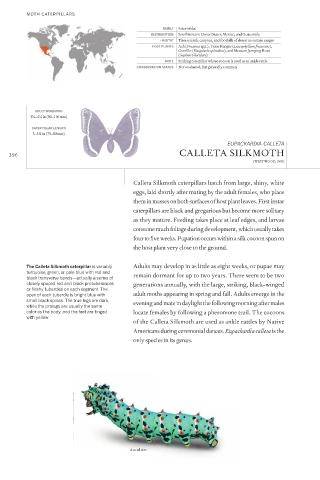
         The Calleta Silkmoth caterpillar is variably   Adults may develop in as little as eight weeks, or pupae may
         turquoise, green, or pale blue with red and   remain dormant for up to two years. There seem to be two
         black transverse bands—actually a series of
         closely spaced red and black protuberances   generations annually, with the large, striking, black-winged
         or   eshy tubercles on each segment. The
         apex of each tubercle is bright blue with   adult moths appearing in spring and fall. Adults emerge in the
         small black spines. The true legs are dark,   evening and mate in daylight the following morning after males
         while the prolegs are usually the same
         color as the body, and the feet are tinged   locate females by following a pheromone trail. The cocoons
         with yellow.
                                            of the Calleta Silkmoth are used as ankle rattles by Native
                                            Americans during ceremonial dances. Eupackardia calleta is the
                                            only species in its genus.


                                          Actual size

