


Page 399 - The Book of Caterpillars: A Life-Size Guide to Six Hundred Species From Around the World
P. 399
MOTH CATERPILLARS

                      FAMILY  Saturniidae
                  DISTRIBUTION
                  DISTRIBUTION  Angola, Zambia, Malawi, and Mozambique, south to South Africa
                    TRIBUTION
                  DIS
                     HABIT
                     HABITAT T  Grasslands, low forests, and semideserts
                        A
                     HABITAT
                  HOS
                  HOST PLANTS S  Many trees, especially Mopane (Colophospermum mopane)
                    T PLANT
                  HOST PLANTS
                      NOTE
                        TE
                      NOTE  Caterpillar that is a popular South African food
                      NO
             CONSERV A TION S T A TUS  Not evaluated, but widespread, though disappearing in some areas
             CONSERVATION STATUS
             CONSERVATION STATUS
                                                                                   ADULT WINGSPAN
                                                                                 4⅛–5½ in (105–140 mm)
                                                                                  CATERPILLAR LENGTH
                                                                                    4 in (100 mm)
            GONIMBRASIA BELINA
            MOPANE WORM                                                                          397
            WESTWOOD, 1849


            The celebrated Mopane, or Mopani, Worm, feeds on the
            widespread Mopane tree in many habitats of southern Africa.
            The caterpillars hatch in spring in subequatorial Africa and
            complete  ve instars during the summer before burrowing in

            the ground to pupate for the winter, emerging as moths the
            following spring. This silkmoth caterpillar is widely eaten,
            and its commercialization is a multimillion dollar business in
            southern Africa. It is smoked, dried, or canned in tomato or chili
            sauce and sold in supermarkets. The adult Mopane Moth and
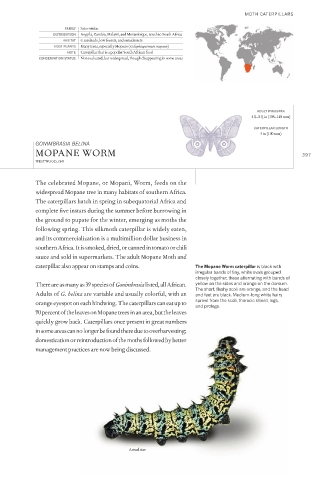
            caterpillar also appear on stamps and coins.       The Mopane Worm caterpillar is black with
                                                               irregular bands of tiny, white ovals grouped
                                                               closely together, these alternating with bands of
            There are as many as 39 species of Gonimbrasia listed, all African.   yellow on the sides and orange on the dorsum.
            Adults of G. belina are variable and usually colorful, with an   The short,   eshy scoli are orange, and the head
                                                               and feet are black. Medium-long white hairs
            orange eyespot on each hindwing. The caterpillars can eat up to   sprawl from the scoli, thoracic shield, legs,
                                                               and prolegs.
            90 percent of the leaves on Mopane trees in an area, but the leaves
            quickly grow back. Caterpillars once present in great numbers
            in some areas can no longer be found there due to overharvesting;
            domestication or reintroduction of the moths followed by better
            management practices are now being discussed.


                                          Actual size

