


Page 543 - The Book of Caterpillars: A Life-Size Guide to Six Hundred Species From Around the World
P. 543
MOTH CATERPILLARS

                      FAMILY  Erebidae
                  DISTRIBUTION  Southern China, Chinese Taipei, Southeast Asia, the Philippines,
                           New Guinea, and northeastern Australia
                     HABITAT  Lowland to montane forests and cultivated land

                  HOST PLANTS  Many, including Mango (Mangifera indica),  g (Ficus spp.),
                           Oil Palm (Elaeis guineensis), Sal (Shorea robusta), Eucalyptus spp.,
                           and Brassica spp.
                      NOTE  Vibrantly colored, hairy caterpillar that has a startling
                           defense strategy
             CONSERVATION STATUS  Not evaluated, but very common


                                                                                   ADULT WINGSPAN
                                                                                  1 ⁄  –2⅜ in (40–60 mm)
                                                                                  CATERPILLAR LENGTH
                                                                                    2 in (50 mm)
            CALLITEARA HORSFIELDII
            HORSFIELD’S TUSSOCK MOTH                                                             541

            (SAUNDERS, 1851)


            Despite their striking, yellow hirsuteness, Calliteara hors eldii

            caterpillars can remain remarkably inconspicuous on the
            shaded underside of leaves. If disturbed, however, they arch
            their thorax, exposing a contrasting pitch-black, intersegmental
            membrane. This may be su ciently startling to deter a predator


            or even give the impression of a vertebrate’s opening eye. The
            species completes seven larval instars over a 50 to 60 day period
            and then pupates within inverted hollows created between

            silk-woven host plant leaves. A silken pad is  rst laid, and then a
            see-through but sturdy twin-layered cocoon incorporating the
            lengthy hairs of the caterpillar is constructed. The pupal period
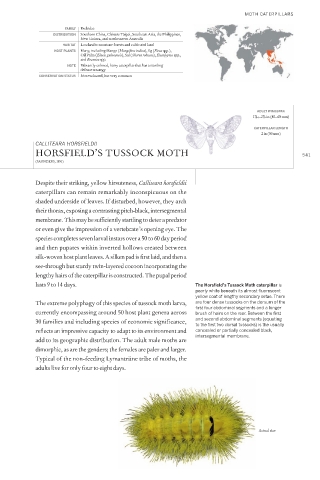
            lasts 9 to 14 days.                                The Hors eld’s Tussock Moth caterpillar is

                                                               pearly white beneath its almost   uorescent
                                                               yellow coat of lengthy secondary setae. There
            The extreme polyphagy of this species of tussock moth larva,   are four dense tussocks on the dorsum of the
            currently encompassing around 50 host plant genera across     rst four abdominal segments and a longer
                                                               brush of hairs on the rear. Between the   rst
            30 families and including species of economic significance,   and second abdominal segments (equating
                                                               to the   rst two dorsal tussocks) is the usually
            re ects an impressive capacity to adapt to its environment and   concealed or partially concealed black,

            add to its geographic distribution. The adult male moths are   intersegmental membrane.
            dimorphic, as are the genders; the females are paler and larger.
            Typical of the non-feeding Lymantriine tribe of moths, the
            adults live for only four to eight days.


                                                                                    Actual size

