


Page 544 - The Book of Caterpillars: A Life-Size Guide to Six Hundred Species From Around the World
P. 544
MOTH CATERPILLARS

                                                     FAMILY  Erebidae
                                                 DISTRIBUTION  Europe and across Asia to Japan
                                                    HABITAT  Deciduous woodlands, scrub, and parklands
                                                  HOST PLANTS  Various trees and shrubs, including birch (Betula spp.),
                                                          hawthorn (Crataegus spp.), and willow (Salix spp.),
                                                          as well as hop (Humulus spp.)
                                                      NOTE  Hairy, potentially defoliating caterpillar that was once
                                                          dubbed “hop-dog”
                                             CONSERVATION STATUS  Not evaluated


            ADULT WINGSPAN
           1 ⁄  –2⅜ in (40–60 mm)
           CATERPILLAR LENGTH
           1 ⁄  –2 in (40–50 mm)
                                                                        CALLITEARA PUDIBUNDA
                                                                   PALE TUSSOCK
    542
                                                                                   (LINNAEUS, 1758)


                                            Pale Tussock caterpillars hatch from 300 to 400 eggs laid in
                                            batches on the underside of leaves. Initially, the larvae are
                                            gregarious but become solitary in the latter stages. The brightly
                                            colored hairs are a warning to deter potential predators, as they
                                            can cause irritation and detach easily,  lling the mouth of an

                                            animal or the bill of a bird. The caterpillars crawl to the ground
                                            to pupate, spinning their cocoon among the leaf litter, and
                                            overwinter in the cocoon. The moths are on the wing from April
                                            to June with just one generation a year.


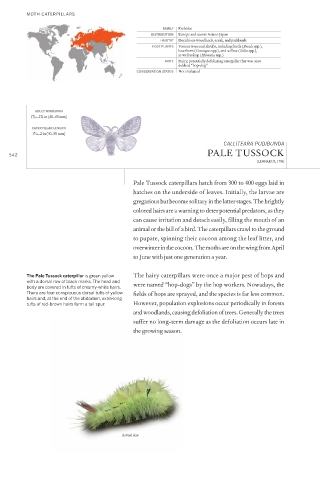
          The Pale Tussock caterpillar is green yellow   The hairy caterpillars were once a major pest of hops and
          with a dorsal row of black marks. The head and   were named “hop-dogs” by the hop workers. Nowadays, the
          body are covered in tufts of creamy-white hairs.

          There are four conspicuous dorsal tufts of yellow    elds of hops are sprayed, and the species is far less common.
          hairs and, at the end of the abdomen, extra-long
          tufts of red-brown hairs form a tail spur.   However, population explosions occur periodically in forests
                                            and woodlands, causing defoliation of trees. Generally the trees
                                            suffer no long-term damage as the defoliation occurs late in
                                            the growing season.


                                        Actual size

