


Page 545 - The Book of Caterpillars: A Life-Size Guide to Six Hundred Species From Around the World
P. 545
MOTH CATERPILLARS

                      FAMILY  Erebidae
                  DISTRIBUTION  North America, from southeastern Canada to northern Georgia,
                           west to Texas
                     HABITAT  Mountainous woodlands and mesic forests
                  HOST PLANTS  Meadow-rue (Thalictrum spp.)

                      NOTE  Caterpillar that mimics saw y larvae
             CONSERVATION STATUS  Not evaluated


                                                                                   ADULT WINGSPAN
                                                                                  1 ⁄  –1 ⁄   in (33–40 mm)
                                                                                  CATERPILLAR LENGTH
                                                                                    1⅜ in (35 mm)


            CALYPTRA CANADENSIS
            CANADIAN OWLET                                                                       543
            (BETHUNE, 1865)


            The Canadian Owlet caterpillar feeds speci cally on Thalictrum

            plants. The larvae are most commonly spotted in damp
            woodlands at higher elevations, in terrain where their host
            plant grows. A single generation is typical within its normal
            range, with two generations possible farther west. In the eastern
            United States, mature caterpillars can be found from early July
            throughout the summer. The pupae overwinter. The adult
            moths are fruit piercers (subfamily Calpinae) and are attracted to
            light. They  y from June to September. Some moths reportedly

            stray to the south and west of the species’ general range.
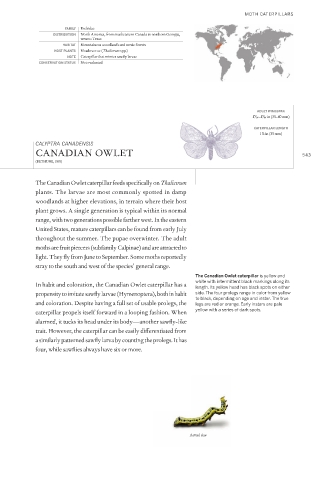
                                                               The Canadian Owlet caterpillar is yellow and
            In habit and coloration, the Canadian Owlet caterpillar has a   white with intermittent black markings along its
                                                               length. Its yellow head has black spots on either

            propensity to imitate saw y larvae (Hymenoptera), both in habit   side. The four prolegs range in color from yellow
            and coloration. Despite having a full set of usable prolegs, the   to black, depending on age and instar. The true
                                                               legs are red or orange. Early instars are pale
            caterpillar propels itself forward in a looping fashion. When   yellow with a series of dark spots.
            alarmed, it tucks its head under its body—another saw y-like


            trait. However, the caterpillar can be easily di erentiated from
            a similarly patterned saw y larva by counting the prolegs. It has

            four, while saw ies always have six or more.


                                                              Actual size

