


Page 546 - The Book of Caterpillars: A Life-Size Guide to Six Hundred Species From Around the World
P. 546
MOTH CATERPILLARS

                                                     FAMILY  Erebidae
                                                 DISTRIBUTION  North Africa, Mediterranean Europe, Turkey, southern Russia,
                                                          and central Asia
                                                    HABITAT  Warm oak forests
                                                  HOST PLANTS  Oak (Quercus spp.)
                                                      NOTE  Twiglike caterpillar that is well hidden on oak trees
                                             CONSERVATION STATUS  Not evaluated, but classed as rare in some parts of its range


            ADULT WINGSPAN
           2 ⁄  –3⅝ in (65–92 mm)


           CATERPILLAR LENGTH
           2–2¾ in (50–70 mm)
                                                                             CATOCALA DILECTA
                                                          CATOCALA DILECTA
    544
                                                                                    (HÜBNER, 1808)


                                            The caterpillars of the Catocala dilecta moth hatch in late
                                            spring from eggs that overwinter in the bark crevices of the
                                            host trees where they were laid. The hatching coincides with
                                            the opening of the leaves, and the larvae are then active from
                                            April to June. Their bark-like cryptic coloration provides the
                                            perfect camou age, so they are di cult to spot when resting on


                                            twigs and branches. The caterpillars pupate in the tree canopy,
                                            spinning their wispy, yellow cocoon between leaves.
                                            The adult moths are on the wing from late June through
                                            September, with a single generation each year. Reliance on a
                                            single host plant means numbers of this species are declining,
                                            a situation exacerbated by the clearance of oak forest, especially
                                            in the Mediterranean countries, and the use of pesticides against
                                            forest pests, which usually wipes out all moth and butterfly
                                            species and not just the target species.


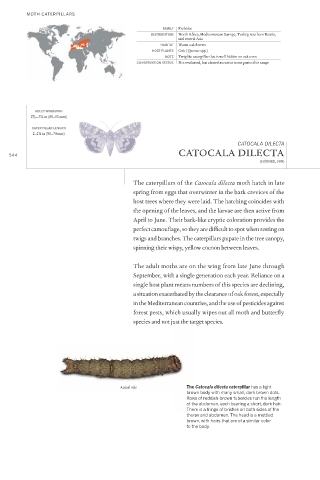
                                       Actual size           The Catocala dilecta caterpillar has a light
                                                             brown body with many small, dark brown dots.
                                                             Rows of reddish-brown tubercles run the length
                                                             of the abdomen, each bearing a short, dark hair.
                                                             There is a fringe of bristles on both sides of the
                                                             thorax and abdomen. The head is a mottled
                                                             brown, with hairs that are of a similar color
                                                             to the body.

