


Page 547 - The Book of Caterpillars: A Life-Size Guide to Six Hundred Species From Around the World
P. 547
MOTH CATERPILLARS

                      FAMILY  Erebidae
                  DISTRIBUTION  From eastern Spain east through southern and central Europe,
                           southern Russia, and the Causasus to China, Korea, and Japan
                     HABITAT  Damp woodlands and scrub in river valleys
                  HOST PLANTS  Willow (Salix spp.) and, less often, poplar (Populus spp.)
                      NOTE  Smooth caterpillar that lives mainly on smooth-barked trees
             CONSERVATION STATUS  Not evaluated


                                                                                   ADULT WINGSPAN
                                                                                  2 ⁄  –3⅛ in (65–80 mm)
                                                                                  CATERPILLAR LENGTH
                                                                                  2⅛–3⅛ in (55–65 mm)
            CATOCALA ELECTA
            ROSY UNDERWING                                                                       545

            (VIEWEG, 1790)


            The Rosy Underwing caterpillar hatches from an egg that is
            grayish with purple blotches and laid in a bark crevice on a trunk
            or branch. The egg overwinters, and the caterpillar hatches
            in April or May and is fully grown in June or July. Its habits
            are similar to those of closely related species such as the Red
            Underwing (Catocala nupta). The larva feeds at night, resting by
            day on a twig, branch, or trunk. The pupa is formed on the food
            plant, in a cocoon, either between spun leaves or in a crevice.


            Like many Catocala caterpillars feeding on willow and poplar,

            the Rosy Underwing is rather smooth, giving good camou age
            on the bark of many of those trees. It is distinguished from the
            Red Underwing by the large, yellow (rather than brown or gray)
            wart on the sixth segment and the brighter, more orange-brown,
            paired warts along its back. The adults, which have pink and

            black hindwings,  y from July to September in one generation.


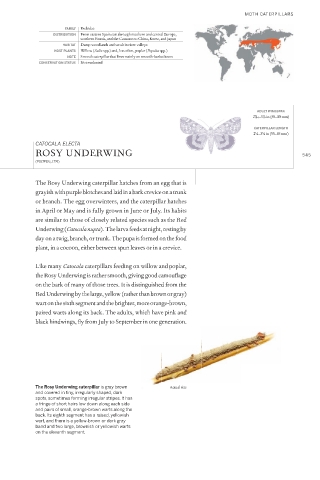
            The Rosy Underwing caterpillar is gray brown   Actual size
            and covered in tiny, irregularly shaped, dark
            spots, sometimes forming irregular stripes. It has
            a fringe of short hairs low down along each side
            and pairs of small, orange-brown warts along the
            back. Its eighth segment has a raised, yellowish
            wart, and there is a yellow-brown or dark gray
            band and two large, brownish or yellowish warts
            on the eleventh segment.

