


Page 548 - The Book of Caterpillars: A Life-Size Guide to Six Hundred Species From Around the World
P. 548
MOTH CATERPILLARS

                                                     FAMILY  Erebidae
                                                 DISTRIBUTION  Western Europe (including southern England, where it has
                                                          recently recolonized) to the Middle East, and across Asia to
                                                          Russian Far East and Japan
                                                    HABITAT  Usually woodlands and well-wooded areas
                                                  HOST PLANTS  Mainly Aspen (Populus tremula) and other poplars (Populus spp.);
                                                          also ash (Fraxinus spp.), oak (Quercus spp.), willow (Salix spp.),
                                                          European Beech (Fagus sylvatica), and other trees
                                                      NOTE  Cryptic caterpillar that appears to move some distance
                                                          before feeding
                                             CONSERVATION STATUS  Not evaluated, but common within most of its range


            ADULT WINGSPAN
           3½–4⅜ in (90–112 mm)
           CATERPILLAR LENGTH
           2 ⁄  –3 in (65–75 mm)
                                                                             CATOCALA FRAXINI
                                                         CLIFDEN NONPAREIL
    546
                                                                                   (LINNAEUS, 1758)


                                           The Clifden Nonpareil caterpillar hatches from an egg that is
                                           grayish and domed with vertical ridges. The egg overwinters
                                           on a branch or trunk, and the caterpillar hatches in May or June.
                                           Observed in captivity, at  rst the larva crawls constantly for

                                           many hours before settling to feed. Later, it feeds at night and
                                           rests along a branch, like other Catocala caterpillars, stretched
                                           out with the legs often splayed sideways. The caterpillar is fully
                                           grown in July and forms a pupa on the food plant, in a cocoon,
                                           often between leaves drawn together.


                                           The behavior of the young caterpillar suggests that it normally
                                           lives high in the tree and must move a long way before feeding.
                                           When larger, it is sluggish when handled. The caterpillar is
                                           rarely seen in the wild; its shape, color, and fringe of lateral
                                           hairs make it highly cryptic. The adults, with blue-and-black
                                           hindwings,  y from August to October in a single generation.

                                           They regularly migrate outside the breeding range. The species’
                                           alternative common name is Blue Underwing.


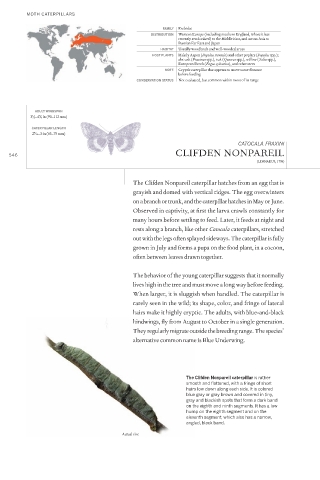
                                                            The Clifden Nonpareil caterpillar is rather
                                                            smooth and   attened, with a fringe of short
                                                            hairs low down along each side. It is colored
                                                            blue gray or gray brown and covered in tiny,
                                                            gray and blackish spots that form a dark band
                                                            on the eighth and ninth segments. It has a low
                                                            hump on the eighth segment and on the
                                                            eleventh segment, which also has a narrow,
                                                            angled, black band.
                                        Actual size

