


Page 549 - The Book of Caterpillars: A Life-Size Guide to Six Hundred Species From Around the World
P. 549
MOTH CATERPILLARS

                      FAMILY  Erebidae
                  DISTRIBUTION
                  DISTRIBUTION
                  DIS TRIBUTION  United States and southern Canada
                     HABITAT T  Oak forests and suburbs where oaks are present
                     HABIT
                     HABITAT
                        A
                  HOST PLANTS
                  HOST PLANTS
                  HOS T PLANT S  Oak (Quercus spp.), including black, red, and white oaks
                      NOTE
                      NOTE
                      NO TE  Cryptic caterpillar that blends with lichens on tree bark
             CONSERV A TION S T A TUS  Not evaluated, but common
             CONSERVATION STATUS
             CONSERVATION STATUS
                                                                                   ADULT WINGSPAN
                                                                                  2 ⁄  –3¼ in (65–82 mm)
                                                                                  CATERPILLAR LENGTH
                                                                                  2⅜–2¾ in (60–70 mm)
            CATOCALA ILIA
            ILIA UNDERWING                                                                       547

            CRAMER, 1780


            Ilia Underwing caterpillars hatch in the spring from eggs
            that have overwintered. The species is most common in
            eastern North America, where studies suggest that the larvae
            prefer to feed on the Bear or Scrub Oak (Quercus ilicifolia).
            In Connecticut, they hatch in the last few days of April and feed
            on fresh growth, which is the only food suitable for the young
            caterpillars. Catocala larvae are all cryptic, their colors blending
            with the bark on which they rest, although C. ilia occasionally

            mimics brighter lichens. Their camou age defense and diet of
            large, nontoxic trees indicate that the larvae are palatable to birds
            and other predators. Following pupation, adults eclose and  y

            from June to September.


            Worldwide there are more than 150 di erent Catocala species,
            providing a uniform group collectively referred to as
            “underwings” for their mostly bright-colored hindwings, which
            are hidden at rest beneath cryptic forewings. In the western
            United States, the subspecies C. ilia zoe is quite distinctive and
            possibly represents a different species from the eastern
            populations. Catocala ilia is most easily confused with C.
            aholibah, another oak-feeding species.

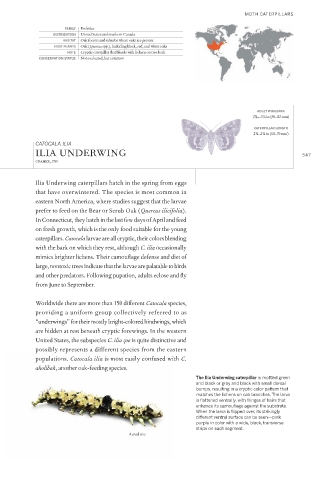
                                                                The Ilia Underwing caterpillar is mottled green
                                                                and black or gray and black with small dorsal
                                                                bumps, resulting in a cryptic color pattern that
                                                                matches the lichens on oak branches. The larva
                                                                is   attened ventrally, with fringes of hairs that
                                                                enhance its camou  age against the substrate.
                                                                When the larva is   ipped over, its strikingly
                                                                di  erent ventral surface can be seen—pink
                                                                purple in color with a wide, black, transverse
                                                                stripe on each segment.
                                          Actual size

