


Page 550 - The Book of Caterpillars: A Life-Size Guide to Six Hundred Species From Around the World
P. 550
MOTH CATERPILLARS

                                                     FAMILY  Erebidae
                                                 DISTRIBUTION  Western Europe to Asia Minor, across Asia to northern China,
                                                          Russian Far East, and Japan
                                                    HABITAT  Woodlands, wetland margins, hedgerows, and gardens
                                                  HOST PLANTS  Willow (Salix spp.) and poplar (Populus spp.)
                                                      NOTE  Typical Catocala caterpillar, feeding by day and hiding by night
                                             CONSERVATION STATUS  Not evaluated, but common within most of its range


            ADULT WINGSPAN
           2¾–3½ in (70–90 mm)
           CATERPILLAR LENGTH
           2⅜–2¾ in (60–70 mm)
                                                                              CATOCALA NUPTA
                                                               RED UNDERWING
    548
                                                                                   (LINNAEUS, 1767)


                                            The Red Underwing caterpillar hatches in April or May from
                                            a gray-brown, ribbed egg that overwinters where it was laid
                                            in a crevice on the trunk of the host plant. In captivity, the larva
                                            is initially very restless. In the wild, it ascends the tree to feed at
                                            night, hiding in a crevice on the trunk or branch by day. It is fully
                                            fed in July. The pupa is formed on the food plant, in a cocoon
                                            either between spun together leaves or in a crevice.


                                            Catocala nupta is not dissimilar to the Clifden Nonpareil
                                            (C. fraxini), although that species lacks the pairs of brown warts
                                            and the dark hairs of this caterpillar. The caterpillars of a number
                                            of other Catocala species feed on willows and poplars and are
                                            similar in appearance and life history to the Red Underwing,

                                            only di ering from one another in the detail of warts, humps,

                                            pattern, and coloring. Adult Red Underwings  y from August
                                            to October in a single generation.


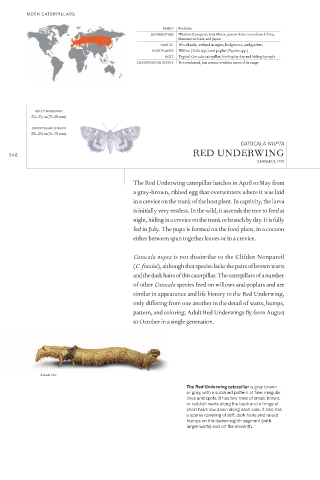
              Actual size
                                                             The Red Underwing caterpillar is gray brown
                                                             or gray, with a subdued pattern of   ne, irregular
                                                             lines and spots. It has two rows of small, brown,
                                                             or reddish warts along the back and a fringe of
                                                             short hairs low down along each side. It also has
                                                             a sparse covering of sti  , dark hairs and raised
                                                             humps on the darker eighth segment (with
                                                             larger warts) and on the eleventh.

