


Page 551 - The Book of Caterpillars: A Life-Size Guide to Six Hundred Species From Around the World
P. 551
MOTH CATERPILLARS

                      FAMILY  Erebidae
                  DISTRIBUTION  Western Europe, east to the Urals, North Africa, and Asia Minor
                     HABITAT  Warm, usually dry woodlands with abundant oak
                  HOST PLANTS  Oak (Quercus spp.), including Pedunculate Oak (Q. robur),
                           Sessile Oak (Q. petraea), and Downy Oak (Q. pubescens)

                      NOTE  Less smooth Catocala caterpillar, re ecting its knobbly food plants
             CONSERVATION STATUS  Not evaluated


                                                                                   ADULT WINGSPAN
                                                                                  2⅜–3⅛ in (60–80 mm)
                                                                                  CATERPILLAR LENGTH
                                                                                  2⅛–2 ⁄   in (55–65 mm)
            CATOCALA SPONSA
            DARK CRIMSON UNDERWING                                                               549

            (LINNAEUS, 1767)


            The Dark Crimson Underwing caterpillar hatches in April from
            a slightly  attened, spherical, brown-and-yellow egg that has

            overwintered. The larva is fully grown in June. It feeds at night,
            when it is most easily found, and conceals itself by day on a
            branch or trunk, often in a crevice. The pupa, which like that
            of other Catocala species, is covered in a bluish-white bloom,
            is formed on the food plant, in a cocoon constructed either
            between spun leaves or in a crevice or hollow on a limb.


            Compared to Catocala species that feed on willow and poplar,
            the Dark Crimson Underwing caterpillar is less smooth in
            appearance, with larger warts and humps, re ecting the more

            irregular, knobbly appearance of oak twigs and branches. The
            caterpillar of C. dilecta, also found on oak in warm forests,
            is very similar but lacks the pale patches of C. sponsa. Adult
            Dark Crimson Underwings  y from late July to mid-October

            in one generation.


                                                                           Actual size
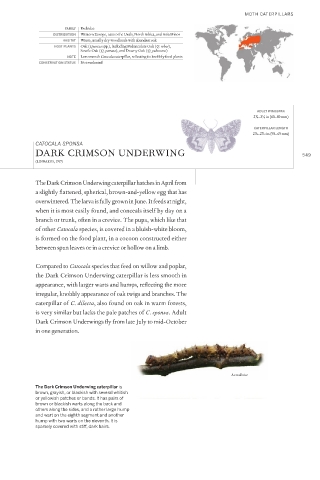
            The Dark Crimson Underwing caterpillar is
            brown, grayish, or blackish with several whitish
            or yellowish patches or bands. It has pairs of
            brown or blackish warts along the back and
            others along the sides, and a rather large hump
            and wart on the eighth segment and another
            hump with two warts on the eleventh. It is
            sparsely covered with sti  , dark hairs.

