


Page 552 - The Book of Caterpillars: A Life-Size Guide to Six Hundred Species From Around the World
P. 552
MOTH CATERPILLARS

                                                     FAMILY  Erebidae
                                                 DISTRIBUTION  The Himalayas, northeast India, southern China, Chinese Taipei,
                                                          Borneo, Sulawesi, and southern islands of Japan
                                                    HABITAT  Low- and medium-altitude montane forests
                                                  HOST PLANTS  Lichen, moss, and algae

                                                      NOTE  Hairy caterpillar that grazes micro ora from tree trunks
                                                          and branches
                                             CONSERVATION STATUS  Not evaluated, but can be very common


            ADULT WINGSPAN
           2⅛–2⅛ in (55–60 mm)
           CATERPILLAR LENGTH


           1⅜–1 ⁄   in (35–40 mm)
                                                                        CHRYSAEGLIA MAGNIFICA
                                                CHRYSAEGLIA MAGNIFICA
    550
                                                                                    (WALKER, 1862)


                                            Chrysaeglia magni ca caterpillars feed on lichens (a symbiosis

                                            of fungi and algae) and their associated mosses and algae.
                                            As a result, the larvae are not routinely found on foliage except
                                            perhaps to molt or pupate. They graze on tree trunks, rocks,
                                            and even man-made structures, where such micro ora abound,

                                            usually in damp, dark habitats. Their diet makes them distasteful
                                            to potential predators and they confer that defense to the adult
                                            moths. The nature and composition of the caterpillar diet,
                                            which is not highly nutritious, also means that the larval stage is
                                            prolonged. The caterpillars relocate to feed or pupate, escaping
                                            threats by descending on silken lines.


                                            Pupation occurs beneath a silken sheet on the surface of a leaf.
                                            The adult moths are metallic blue and orange and  y nocturnally

                                            from July to September. Chrysaeglia magnifica and other
                                            members of their Lithosiini tribe can collectively be called lichen
                                            moths, and C. magni ca caterpillars also have the extremely long

                                            body hairs that are typical of their tribe.


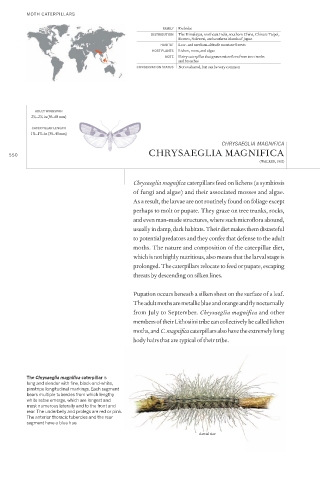
          The Chrysaeglia magni ca caterpillar is
          long and slender with   ne, black-and-white,
          pinstripe longitudinal markings. Each segment
          bears multiple tubercles from which lengthy
          white setae emerge, which are longest and
          most numerous laterally and to the front and
          rear. The underbelly and prolegs are red or pink.
          The anterior thoracic tubercles and the rear
          segment have a blue hue.
                                                                Actual size

