


Page 553 - The Book of Caterpillars: A Life-Size Guide to Six Hundred Species From Around the World
P. 553
MOTH CATERPILLARS

                      FAMILY  Erebidae
                  DISTRIBUTION
                    TRIBUTION
                  DISTRIBUTION  Eastern Ecuador
                  DIS
                     HABITAT
                     HABIT
                     HABITAT T  Edges of humid and semi-humid montane forests
                        A
                  HOST PLANTS
                  HOST PLANTS
                  HOS T PLANT S  Unknown genus in the plant family Boraginaceae
                      NO
                      NOTE
                      NOTE  Caterpillar whose coloration and behavior suggest it is unpalatable
                        TE
                   TION S
                  A
                      T
                       TUS
                       A
             CONSERVATION STATUS
             CONSERV
             CONSERVATION STATUS  Not evaluated, but not considered threatened
                                                                                   ADULT WINGSPAN
                                                                                 1  ⁄  –1  ⁄   in (43–49 mm)
                                                                                  CATERPILLAR LENGTH


                                                                                  1⅜–1¾ in (35–45 mm)
            CROCOMELA ERECTISTRIA
            CROCOMELA ERECTISTRIA                                                                551
            (WARREN, 1904)
            The Crocomela erectistria caterpillar is fairly slender but appears
            larger due to its setae-covered body. It is unequivocally
            aposematic, calling attention to itself with bright yellow and
            metallic blue markings. The caterpillars of this species feed in
            groups of 10 to15 individuals, resting on the upper surface of
            leaves—behavior that adds to their warning advertisement.
            When disturbed, they lift their front and rear portions from the
            surface of the leaf and thrash them about vigorously.


            Within its fairly restricted known range, Crocomela erectistria is
            relatively rare, with only one group of caterpillars ever having
            been collected and reared (in northeastern Ecuador). Because
            the caterpillars have been found feeding in large groups, it is
            assumed that eggs are laid in large groups also; other aspects
            of the life cycle of this species, however, remain undiscovered.
            The brightly colored adults, seen more frequently than the
            caterpillars, are weak, daytime fliers, sometimes observed
            feeding at moist sand or roadside puddles.


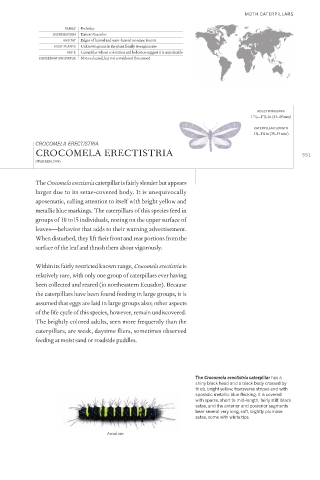
                                                               The Crocomela erectistria caterpillar has a
                                                               shiny black head and a black body crossed by
                                                               thick, bright yellow, transverse stripes and with
                                                               sporadic metallic blue   ecking. It is covered
                                                               with sparse, short to mid-length, fairly sti  , black
                                                               setae, and the anterior and posterior segments
                                                               bear several very long, soft, slightly plumose
                                                               setae, some with white tips.

                                   Actual size

