


Page 554 - The Book of Caterpillars: A Life-Size Guide to Six Hundred Species From Around the World
P. 554
MOTH CATERPILLARS

                                                     FAMILY  Erebidae
                                                 DISTRIBUTION
                                                 DISTRIBUTION  Eastern Ecuador
                                                   TRIBUTION
                                                 DIS
                                                    HABIT A T  Cloud forest edges, second growth, and regenerating landslides
                                                    HABITAT
                                                    HABITAT
                                                  HOS T PLANT S  Chusquea scandens and Baccharis latifolia
                                                  HOST PLANTS
                                                  HOST PLANTS
                                                      NO
                                                      NOTE  Rarely seen caterpillar that is vulnerable to parasitization
                                                       TE
                                                      NOTE
                                             CONSERVATION STATUS
                                             CONSERVATION STATUS
                                             CONSERV A TION S T A TUS  Not evaluated, but not considered threatened
            ADULT WINGSPAN
           1¼–1½ in (32–38 mm)
           CATERPILLAR LENGTH

           1⅜–1 ⁄   in (35–40 mm)

                                                                          DESMOTRICHA IMITATA
                                                    DESMOTRICHA IMITATA
    552
                                                                                     (DRUCE, 1883)


                                            Desmotricha imitata caterpillars are solitary in nature, and that,
                                            together with their tendency to rest on the lower side of leaves,
                                            make them di cult to detect on the dense foliage of their host


                                            plants. Beating methods are used most frequently to knock and
                                            collect the larvae from the plant. It is not known if the caterpillars
                                            are palatable to predators, but they are known to be parasitized
                                            by several species of wasps from the families Braconidae and

                                            Ichneumonidae. Parasitoid  ies in the family Tachinidae also
                                            attack the larvae.


                                            The red, black, and blue coloration of adults makes Desmotricha
                                            imitata an adept wasp mimic as it flies about during the day.
                                            Nevertheless, adults are known to be seized from the air by
                                            at least one forest bird species, the Smoke-colored Pewees
                                            (Contopus fumigatus). Given that the geographic range of its host
                                            plants is fairly substantial, D. imitata may also have a range that
                                            extends beyond eastern Ecuador.


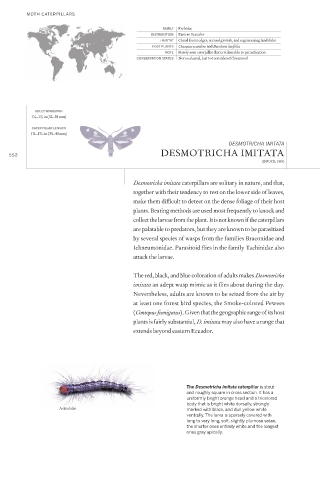
                                                             The Desmotricha imitata caterpillar is stout
                                                             and roughly square in cross section. It has a
                                                             uniformly bright orange head and a tricolored
                                                             body that is bright white dorsally, strongly
                    Actual size                              marked with black, and dull yellow white
                                                             ventrally. The larva is sparsely covered with
                                                             long to very long, soft, slightly plumose setae,
                                                             the shorter ones entirely white and the longest
                                                             ones gray apically.

