


Page 629 - The Book of Caterpillars: A Life-Size Guide to Six Hundred Species From Around the World
P. 629
MOTH CATERPILLARS

                      FAMILY  Noctuidae
                  DISTRIBUTION  Canada and United States, Europe, North Africa, and western
                           Asia into northern India
                     HABITAT  Grasslands, verges, parks, and gardens
                  HOST PLANTS  Wide variety of herbaceous plants and crops, including
                           strawberry (Fragaria spp.), freesia (Freesia spp.), allium spp.,
                           Tomato (Solanum lycopersicum), and potato (Solanum spp.)
                      NOTE  Caterpillar that is widely resented as a garden pest
             CONSERVATION STATUS  Not evaluated, but common


                                                                                   ADULT WINGSPAN
                                                                                  2–2⅜ in (50–60 mm)
                                                                                  CATERPILLAR LENGTH
            NOCTUA PRONUBA                                                        1 ⁄  –1 ⁄   in (30–40 mm)
            LARGE YELLOW
            UNDERWING                                                                            627

            (LINNAEUS, 1758)


            Female Large Yellow Underwing moths lay large clusters of up
            to 1,000 eggs, on the underside of host plant leaves. The eggs

            are slow to hatch, taking up to  ve weeks. The young larvae
            overwinter and feed on milder winter days but become fully
            active in the spring. The caterpillar, also known as a cutworm,
            is a notorious garden pest. It emerges at night to feed on low-
            growing plants, severing the shoots at ground level. By day,
            it seeks shelter in clumps of plants where it may continue to feed
            and curls up into the typical cutworm C shape when disturbed.


            The larvae complete their growth and pupate in a small chamber
            underground. The adult moths eclose from the chestnut-brown
            pupae and are on the wing during summer to early fall. They
            are strong  iers and, being migratory, can travel long distances.

            Accidentally introduced into Canada in 1979, the species has
            now spread west across North America.


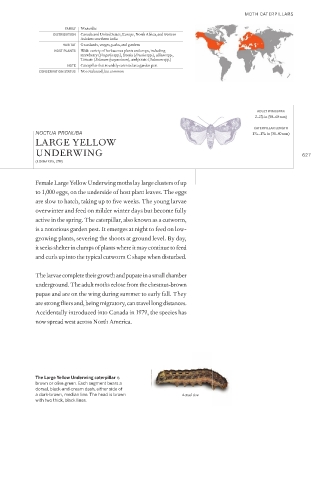
            The Large Yellow Underwing caterpillar is
            brown or olive green. Each segment bears a
            dorsal, black-and-cream dash, either side of
            a dark-brown, median line. The head is brown   Actual size
            with two thick, black lines.

