


Page 26 - (DK) Eyewitness - Mars
P. 26
Martian atmosphere


                                                     The “air,” or atmosphere, of Mars is much thinner
                                                     than Earth’s, and is 95 percent carbon dioxide. Earth’s
                                                     atmosphere is 78 percent nitrogen, 21 percent oxygen.
                                                     The average Martian surface temperature is a bitterly
                                                     cold minus 81°F (-63°C). In the upper Martian
                                                     atmosphere, water and carbon dioxide vapors freeze
                                                     and form high clouds. Other clouds appear over Mars
                                                     when springtime winds puff dust into the air, causing
                                                     great storms. Most of the grit settles down again, but
                                                     fine reddish dust stays suspended in the atmosphere’s
                                                     lowest level—the “troposphere.” Dust colors the sky a
        LOSING AIR IN NOACHIAN TIMES                 rose-orange. In the polar regions, suspended dust
        Billions of years ago, meteor impacts blasted away much
        of the Martian atmosphere. Since then, air has continued   mingles with icy vapors and turns to snowy frost
        to escape because the planet’s gravity is just a third of   that covers the ground.
        Earth’s. Weak gravity allows gases to vanish into space.
        Mars loses more atmosphere in winter, when carbon
        dioxide freezes to the polar caps, but in spring the carbon
        dioxide ice becomes a gas again.
                                                                MARTIAN ATMOSPHERE         Structure
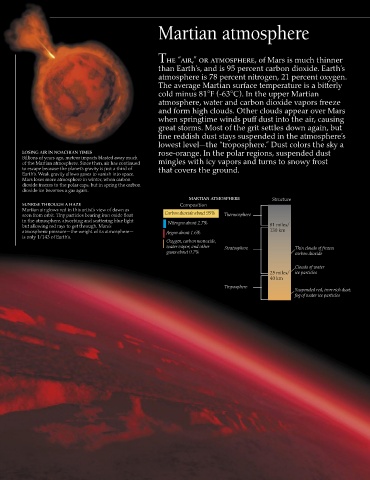
        SUNRISE THROUGH A HAZE                               Composition
        Martian air glows red in this artist’s view of dawn as
        seen from orbit. Tiny particles bearing iron oxide float   Carbon dioxide about 95%  Thermosphere
        in the atmosphere, absorbing and scattering blue light   Nitrogen about 2.7%
        but allowing red rays to get through. Mars’s                                      81 miles/
        atmospheric pressure—the weight of its atmosphere—  Argon about 1.6%              130 km
        is only 1/143 of Earth’s.
                                                        Oxygen, carbon monoxide,
                                                        water vapor, and other   Stratosphere      Thin clouds of frozen
                                                        gases about 0.7%                           carbon dioxide
                                                                                                   Clouds of water
                                                                                          25 miles/  ice particles
                                                                                          40 km
                                                                           Troposphere
                                                                                                   Suspended red, iron-rich dust;
                                                                                                   fog of water ice particles

