


Page 27 - (DK) Eyewitness - Mars
P. 27
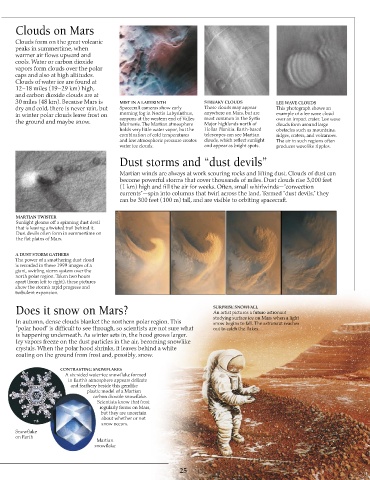
Clouds on Mars

      Clouds form on the great volcanic
      peaks in summertime, when
      warmer air flows upward and
      cools. Water or carbon dioxide
      vapors form clouds over the polar
      caps and also at high altitudes.
      Clouds of water ice are found at
      12–18 miles (19–29 km) high,
      and carbon dioxide clouds are at
      30 miles (48 km). Because Mars is   MIST IN A LABYRINTH        STREAKY CLOUDS         LEE WAVE CLOUDS
      dry and cold, there is never rain, but   Spacecraft cameras show early   These clouds may appear   This photograph shows an
      in winter polar clouds leave frost on   morning fog in Noctis Labyrinthus,   anywhere on Mars, but are   example of a lee wave cloud
      the ground and maybe snow.         canyons at the western end of Valles   most common in the Syrtis   over an impact crater. Lee wave
                                                                     Major highlands north of
                                         Marineris. The Martian atmosphere
                                                                                            clouds form around large
                                         holds very little water vapor, but the   Hellas Planitia. Earth-based   obstacles such as mountains,
                                         combination of cold temperatures   telescopes can see Martian   ridges, craters, and volcanoes.
                                         and low atmospheric pressure creates   clouds, which reflect sunlight   The air in such regions often
                                         water ice clouds.           and appear as bright spots.  produces wavelike ripples.
                                         Dust storms and “dust devils”

                                         Martian winds are always at work scouring rocks and lifting dust. Clouds of dust can
                                         become powerful storms that cover thousands of miles. Dust clouds rise 3,000 feet
                                         (1 km) high and fill the air for weeks. Often, small whirlwinds—“convection
                                         currents”—spin into columns that twirl across the land. Termed “dust devils,” they
                                         can be 300 feet (100 m) tall, and are visible to orbiting spacecraft.

      MARTIAN TWISTER
      Sunlight gleams off a spinning dust devil
      that is leaving a twisted trail behind it.
      Dust devils often form in summertime on
      the flat plains of Mars.

      A DUST STORM GATHERS
      The power of a smothering dust cloud
      is recorded in these 1999 images of a
      giant, swirling storm system over the
      north polar region. Taken two hours
      apart (from left to right), these pictures
      show the storm’s rapid progress and
      turbulent expansion.

      Does it snow on Mars?                                             SURPRISE SNOWFALL
                                                                        An artist pictures a future astronaut
                                                                        studying surface ice on Mars when a light
      In autumn, dense clouds blanket the northern polar region. This   snow begins to fall. The astronaut reaches
      “polar hood” is difficult to see through, so scientists are not sure what   out to catch the flakes.
      is happening underneath. As winter sets in, the hood grows larger.
      Icy vapors freeze on the dust particles in the air, becoming snowlike
      crystals. When the polar hood shrinks, it leaves behind a white
      coating on the ground from frost and, possibly, snow.

                     CONTRASTING SNOWFLAKES
                       A six-sided water-ice snowflake formed
                        in Earth’s atmosphere appears delicate
                        and feathery beside this gemlike
                              plastic model of a Martian
                                carbon dioxide snowflake.
                                 Scientists know that frost
                                  regularly forms on Mars,
                                  but they are uncertain
                                   about whether or not
                                   snow occurs.
      Snowflake
      on Earth
                                 Martian
                                snowflake


                                                            25

