


Page 28 - (DK) Eyewitness - Mars
P. 28
The moons of Mars


        For centuries, astronomers believed Mars had moons, but no one
        could find them. Anglo-Irish author Jonathan Swift accurately
        described Martian moons in his 1726 masterpiece, Gulliver’s Travels,
        yet no one had ever seen them. In 1877, American astronomer
        Asaph Hall finally discovered the Martian moons. Hall found them
        with the powerful telescope of the United States Naval Observatory
        in Washington, D.C. He named them Phobos and Deimos after the
        sons of the Greek god Ares—the equal of the Roman Mars. These
        two tiny satellites are sometimes termed “moonlets.” They may be
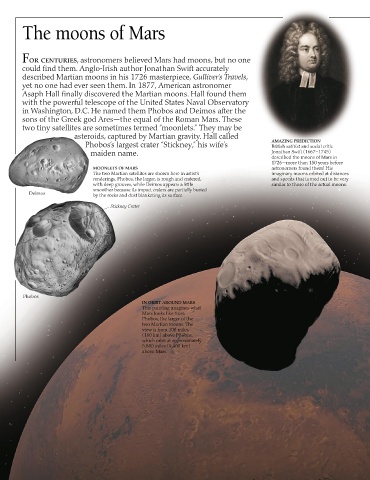
                          asteroids, captured by Martian gravity. Hall called
                             Phobos’s largest crater “Stickney,” his wife’s                AMAZING PREDICTION
                                                                                           British satirist and social critic
                               maiden name.                                                Jonathan Swift (1667–1745)
                                                                                           described the moons of Mars in
                                                                                           1726—more than 150 years before
                                MOONLETS OF MARS                                           astronomers found them! His
                                The two Martian satellites are shown here in artist’s      imaginary moons orbited at distances
                                renderings. Phobos, the larger, is rough and cratered,     and speeds that turned out to be very
                                with deep grooves, while Deimos appears a little           similar to those of the actual moons.
                                smoother because its impact craters are partially buried
           Deimos               by the rocks and dust blanketing its surface.
                                      Stickney Crater


         Phobos
                                                IN ORBIT AROUND MARS
                                                This painting imagines what
                                                Mars looks like from
                                                Phobos, the larger of the
                                                two Martian moons. The
                                                view is from 100 miles
                                                (160 km) above Phobos,
                                                which orbit at approximately
                                                5,800 miles (9,400 km)
                                                above Mars.

