


Page 117 - (DK) Ocean - The Definitive Visual Guide
P. 117
ESTUARIES AND LAGOONS            115


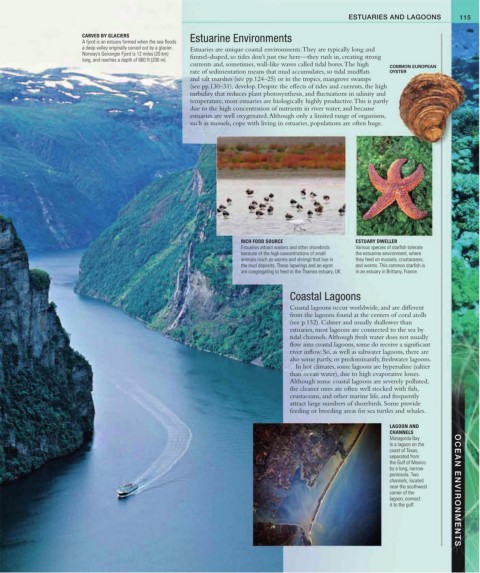
                         CARVED BY GLACIERS               Estuarine Environments
                         A fjord is an estuary formed when the sea floods
                         a deep valley originally carved out by a glacier.   Estuaries are unique coastal environments. They are typically long and
                         Norway’s Geiranger Fjord is 12 miles (20 km)
                         long, and reaches a depth of 660 ft (200 m).  funnel-shaped, so tides don’t just rise here—they rush in, creating strong
                                                          currents and, sometimes, wall-like waves called tidal bores. The high
                                                                                                                     COMMON EUROPEAN
                                                          rate of sedimentation means that mud accumulates, so tidal mudflats    OYSTER
                                                          and salt marshes (see pp.124–25) or in the tropics, mangrove swamps
                                                          (see pp.130–31), develop. Despite the effects of tides and currents, the high
                                                          turbidity that reduces plant photosynthesis, and fluctuations in salinity and
                                                          temperature, most estuaries are biologically highly productive. This is partly
                                                          due to the high concentration of nutrients in river water, and because
                                                          estuaries are well oxygenated. Although only a limited range of organisms,
                                                          such as mussels, cope with living in estuaries, populations are often huge.


                                                                         RICH FOOD SOURCE                  ESTUARY DWELLER
                                                                         Estuaries attract waders and other shorebirds   Various species of starfish tolerate
                                                                         because of the high concentrations of small    the estuarine environment, where
                                                                         animals (such as worms and shrimp) that live in    they feed on mussels, crustaceans,
                                                                         the mud deposits. These lapwings and an egret    and worms. This common starfish is
                                                                         are congregating to feed in the Thames estuary, UK.  in an estuary in Brittany, France.


                                                                                       Coastal Lagoons

                                                                                       Coastal lagoons occur worldwide, and are different
                                                                                       from the lagoons found at the centers of coral atolls
                                                                                       (see p.152). Calmer and usually shallower than
                                                                                       estuaries, most lagoons are connected to the sea by
                                                                                       tidal channels. Although fresh water does not usually
                                                                                       flow into coastal lagoons, some do receive a significant
                                                                                       river inflow. So, as well as saltwater lagoons, there are
                                                                                       also some partly, or predominantly, freshwater lagoons.
                                                                                         In hot climates, some lagoons are hypersaline (saltier
                                                                                       than ocean water), due to high evaporative losses.
                                                                                       Although some coastal lagoons are severely polluted,
                                                                                       the cleaner ones are often well stocked with fish,
                                                                                       crustaceans, and other marine life, and frequently
                                                                                       attract large numbers of shorebirds. Some provide
                                                                                       feeding or breeding areas for sea turtles and whales.

                                                                                                                     LAGOON AND
                                                                                                                     CHANNELS
                                                                                                                     Matagorda Bay
                                                                                                                     is a lagoon on the
                                                                                                                     coast of Texas,
                                                                                                                     separated from
                                                                                                                     the Gulf of Mexico
                                                                                                                     by a long, narrow
                                                                                                                     peninsula. Two
                                                                                                                     channels, located
                                                                                                                     near the southwest
                                                                                                                     corner of the       OCEAN ENVIRONMENTS
                                                                                                                     lagoon, connect
                                                                                                                     it to the gulf.

