


Page 115 - (DK) Ocean - The Definitive Visual Guide
P. 115
BEACHES AND DUNES           113


                PACIFIC OCEAN NORTHEAST    Oregon National Dunes is the largest   stabilized by marram grass. Behind   HUMAN IMPACT
                                           area of coastal sand dunes in North   these are hummocks where sand
             Oregon National               America, extending along the coast    collects around vegetation. Water   DUNE
                                           of Oregon between the Sislaw and   accumulates around the hummocks
             Dunes                         Coos rivers. These dunes have been   seasonally, giving them the appearance   DESTABILIZATION
                                           created through the combined effects   of floating islands. Behind the
                           TYPE  Coastal dunes
                                           of coastal erosion and wind transport   hummocks are further distinct regions,   The use of dune buggies and
                           COMPOSITION  Yellow   of sand over millions of years and   ranging from densely vegetated areas   ATVs, especially when raced
                           sand, grasses, conifers
                                                     1
                                           extend up to 2/2 miles (4 km) inland,   that become marshlike in winter to   in large numbers, may destroy
                           LENGTH  40 miles   rising to 500 ft (150 m) above sea    completely barren, wind-sculpted   the grass on the dunes, making
                           (64 km)
                                           level. A continuum of dry and wet   high dunes. The dunes are a popular   them susceptible to wind
                                           conditions extends through the dune   location for various recreational   scour. This may in turn lead
             LOCATION  Southwest of Portland, Oregon,                                                   to self-propagating breaches in
             northwestern US               area. Close to the beach are low   activities, including riding all-terrain
                                           foredunes of sand and driftwood   vehicles (ATVs) and dune buggies.  the dune ridges. To protect the
                                                                                                        dunes, ATV usage is restricted.


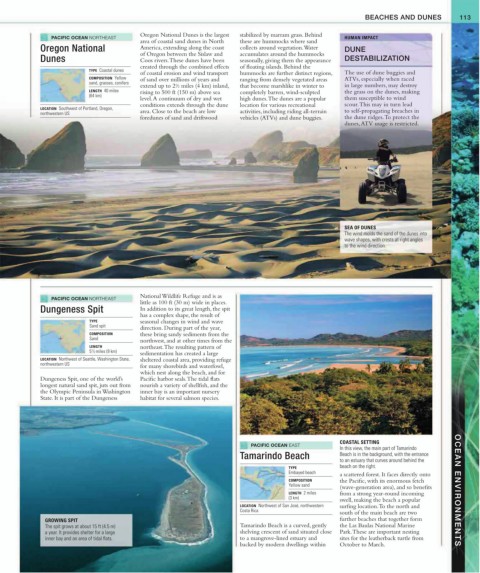
                                                                                                        SEA OF DUNES
                                                                                                        The wind molds the sand of the dunes into
                                                                                                        wave shapes, with crests at right angles
                                                                                                        to the wind direction.


                PACIFIC OCEAN NORTHEAST    National Wildlife Refuge and is as
                                           little as 100 ft (30 m) wide in places.
             Dungeness Spit                In addition to its great length, the spit
                                           has a complex shape, the result of
                            TYPE           seasonal changes in wind and wave
                            Sand spit      direction. During part of the year,
                            COMPOSITION     these bring sandy sediments from the
                            Sand
                                           northwest, and at other times from the
                            LENGTH         northeast. The resulting pattern of
                            5 1 / 2 miles (9 km)
                                           sedimentation has created a large
             LOCATION  Northwest of Seattle, Washington State,   sheltered coastal area, providing refuge
             northwestern US
                                           for many shorebirds and waterfowl,
                                           which nest along the beach, and for
             Dungeness Spit, one of the world’s   Pacific harbor seals. The tidal flats
             longest natural sand spit, juts out from   nourish a variety of shellfish, and the
             the Olympic Peninsula in Washington   inner bay is an important nursery
             State. It is part of the Dungeness   habitat for several salmon species.


                                                                                                      COASTAL SETTING
                                                                            PACIFIC OCEAN EAST
                                                                                                      In this view, the main part of Tamarindo
                                                                        Tamarindo Beach               Beach is in the background, with the entrance
                                                                                                      to an estuary that curves around behind the
                                                                                       TYPE           beach on the right.
                                                                                       Embayed beach  a scattered forest. It faces directly onto
                                                                                       COMPOSITION     the Pacific, with its enormous fetch
                                                                                       Yellow sand    (wave-generation area), and so benefits
                                                                                       LENGTH  2 miles    from a strong year-round incoming   OCEAN ENVIRONMENTS
                                                                                       (3 km)         swell, making the beach a popular
                                                                        LOCATION  Northwest of San José, northwestern   surfing location. To the north and
                                                                        Costa Rica
                                                                                                      south of the main beach are two
              GROWING SPIT                                                                            further beaches that together form
              The spit grows at about 15 ft (4.5 m)                     Tamarindo Beach is a curved, gently   the Las Baulas National Marine
              a year. It provides shelter for a large                   shelving crescent of sand situated close   Park. These are important nesting
              inner bay and an area of tidal flats.                      to a mangrove-lined estuary and  sites for the leatherback turtle from
                                                                        backed by modern dwellings within    October to March.

