


Page 119 - (DK) Ocean - The Definitive Visual Guide
P. 119
117


                ATLANTIC OCEAN WEST        similarly cut off by a string of barrier   ATLANTIC OCEAN SOUTHWEST  sediments driven by tidal action and
                                           islands. The entire lagoon connects                        winds. The salinity of the lagoon
             Laguna Madre                  with the Gulf only via a few narrow   Lagoa dos Patos      varies. It consists mainly of fresh water
                                           channels, and it is less than 3 ft (1 m)                   at times of high rainfall, but there is
                           TYPE            deep in most parts. It is saltier than      TYPE           considerable saltwater intrusion at its
                           Hypersaline coastal                                         Tidal coastal lagoon
                           lagoon          seawater because it receives no input                      southern end at times of drought.
                                           of river water and lies in a hot, dry       AREA           Lagoa dos Patos is one of Brazil’s most
                           AREA                                                        3,900 square miles
                           14,400 square miles   region, leading to high rates of      (10,000 square km)  vital fishing grounds. However,
                           (3,660 square km)   evaporation. Seagrass meadows and                      run-off from rice fields and
                                           several species of crustaceans and                         pastureland, industrial effluents, and
             LOCATION  Southern Texas, US, and northeastern   fish thrive in the lagoon, which also   LOCATION  South of the city of Porto Alegre, southern   increasing population have led to
             Mexico, along the coast of the Gulf of Mexico  supports many wintering shorebirds   Brazil  concerns for the lagoon’s ecosystem.
                                           and waterfowl. Threats to the lagoon’s
             The Laguna Madre is a shallow lagoon   health include dredging, overfishing,   Lagoa dos Patos (“Lagoon of Ducks”)
             in two distinct parts extending about   and algal blooms.  is the world’s largest coastal lagoon.
             285 miles (456 km) along the coast of                      Its name is said to have been given to
             the Gulf of Mexico. Its northern part,   FLY-FISHING FOR REDFISH  it by Jesuit settlers in the 16th century,
             in Texas, is separated from the Gulf by   The sale of licenses for fly-fishing—for trout   who bred waterfowl on its shores. It is
             a long, thin barrier island, Padre Island.   and redfish—in the Laguna provides funds for   a shallow, tidal body of water, 155 miles
             The southern part, in Mexico, is   protecting its water quality and wildlife.  (250 km) long and up to 35 miles
                                                                        (56 km) wide. A sand bar separates
                                                                        it from the Atlantic, with which it
                                                                        connects at its southern end via a
                                                                        short, narrow channel that disgorges a
                                                                        large plume of sediment into the ocean.
                                                                        Marine animals use this channel to
                                                                        access the lagoon; sea turtles are found
                                                                        in the lagoon in spring and summer.
                                                                           At its northern end, the lagoon
                                                                        receives an inflow of fresh water from
                                                                        the Guaíba Estuary, formed from the
                                                                        confluence of the Rio Jacui and three                            OCEAN ENVIRONMENTS
                                                                        smaller rivers. Along its inner side are
                                                                        a number of distinctive wavelike
                                                                        “cusps” that have been caused by the
                                                                        accumulation and erosion of

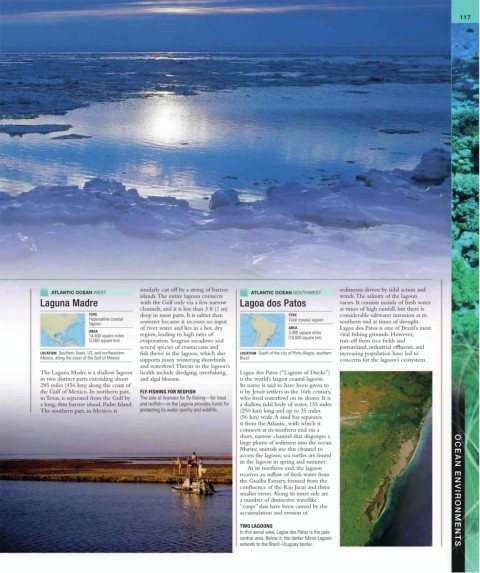
                                                                        TWO LAGOONS
                                                                        In this aerial view, Lagoa dos Patos is the pale
                                                                        central area. Below it, the darker Mirim Lagoon
                                                                        extends to the Brazil–Uruguay border.

