


Page 120 - (DK) Ocean - The Definitive Visual Guide
P. 120
118     COASTS AND THE SEASHORE


                  ATLANTIC OCEAN SOUTHWEST
               Amazon Estuary

                              TYPE  Salt-wedge
                              (river-dominated) estuary
                              AREA  Approximately
                              7,800 square miles
                              (20,000 square km)

               LOCATION  Northern Brazil
                                                                                                          HUMAN IMPACT
               The Amazon Estuary is a stretch of
               the Amazon River that extends more                                                         POROROCA SURF
               than 190 miles (300 km) inland from
               the river’s mouth to an area southwest                                                     Tidal bores, locally called pororocas,
               of the city of Macapà. Varying in width                                                    occur on large spring tides in
               from 15 to 190 miles (25 to 300 km),                                                       several of northern Brazil’s river
               the estuary is partly filled by numerous                                                   estuaries. Some of these bores
               low-lying, forested islands.                                                               attain heights of 10 ft (3 m) and
                 The Amazon Estuary has by far the                                                        can be surfed for several miles.
               largest water output of any estuary in                                                     This sport is rather hazardous,
               the world, discharging an average of                                                       however, because the waters
               45 million gallons (200 million liters)                                                    through which the pororocas surge
               per second into the Atlantic. The sheer                                                    are home to dangerous snakes,
               magnitude of this discharge means                                                          fish, and crocodiles.
               that, almost uniquely among estuaries,
               there is very little saltwater intrusion
               into it. Instead, nearly all of the mixing
               between the river’s discharge and
               seawater occurs outside the estuary, on
               an area of continental shelf. Despite
               the relative lack of seawater intrusion,
               the whole estuary is significantly
               affected by twice-daily tides, which
               cause inundation (by river water) of
               most of the islands in the estuary.
               MARAJO ISLAND
               The Amazon Estuary is so enormous that the
               biggest of the forested islands lying within
               it, Marajo Island, has its own river system.


                  ATLANTIC OCEAN SOUTHWEST   The Plate River, or Rio de la Plata, is   vast amount of water, the estuary   varies uniformly through the estuary,
                                             not a river but a large, funnel-shaped   receives about 2 billion cubic feet   from close to zero in its upper parts
               River Plate                   estuary formed by the confluence of   (57 million cubic meters) of silt each   to a value just below average ocean
                                             the rivers Uruguay and Paraná. These   year from its input rivers. This mud   salinity near its mouth. Deep down,
                              TYPE           rivers and their tributaries drain about   accumulates in great shoals, so that the   a wedge of salt water penetrates deep
                              Salt-wedge
                              (river-dominated) estuary  one-fifth of the land area of South   water depth in most of the estuary is   into the estuary. Biologically, the Plate
                                             America. At 180 miles (290 km) long   less than 10 ft (3 m). Constant dredging   is highly productive, yielding large
                              AREA
                              13,500 square miles   and 136 miles (220 km) wide at its   is therefore needed to maintain   annual masses of plankton, which
                              (35,000 square km)   mouth, the Plate discharges about    deep-water channels to the ports of   support large numbers of fish and dense
                                             6.5 million gallons (25 million liters)   Buenos Aires, which lies near the head   beds of clams. It is also a habitat for
               LOCATION  On the Argentina–Uruguay border, east of   of water per second into the Atlantic   of the estuary, and Montevideo, which   the La Plata Dolphin, an endangered
               Buenos Aires and southwest of Montevideo  Ocean. As well as transporting this    is close to its mouth. Surface salinity   long-beaked species of river dolphin.


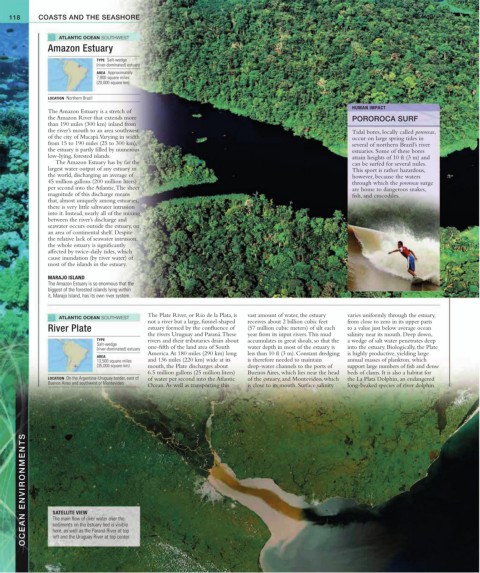
        OCEAN ENVIRONMENTS  SATELLITE VIEW


                 The main flow of river water over the
                 sediments on the estuary bed is visible
                 here, as well as the Paraná River at top
                 left and the Uruguay River at top center.

