


Page 122 - (DK) Ocean - The Definitive Visual Guide
P. 122
120
ATLANTIC OCEAN NORTHEAST hamper navigation. One of the
Gironde’s most impressive features is
Gironde Estuary its tidal bore—a large, wall-like wave
at the leading edge of the incoming
TYPE Fully mixed tide—known locally as the Mascaret.
(tide-dominated) estuary Occurring with each flood tide at the
AREA Approximately time of spring tides (that is, twice daily
200 square miles for a few days every two weeks), the
(500 square km)
bore surges from the Gironde upstream
into its narrower tributaries. On the
LOCATION North of Bordeaux, western France Garonne, the Mascaret sometimes
forms a barreling wave, which can
The Gironde Estuary, formed by reach a height of 5 ft (1.5 m) and
the confluence of the Garonne and tends to break and reform.
Dordogne rivers, is the largest estuary The Gironde is an important artery
in Europe at almost 50 miles (80 km) of the Bordeaux wine region and a
long and up to 7 miles (11 km) wide. rich source of eels and a wide variety
The estuary’s average discharge rate of shellfish, which feature on local
into the Atlantic is 265,000 gallons restaurant menus. Wild sturgeon (the
(1 million liters) per second. It has source of caviar) were once also
a large tidal range, of up to 16 ft (5 m) plentiful in the estuary, and although
during periods of spring tide, and the their numbers have declined due to
strong tidal currents in the estuary, as overfishing, they are still farmed in
well as numerous sand banks, tend to small numbers.
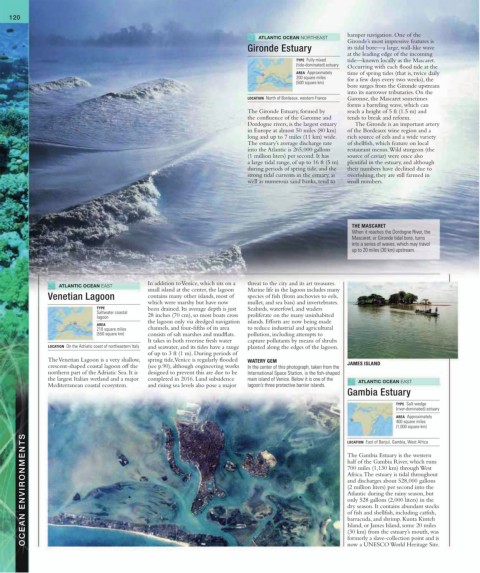
THE MASCARET
When it reaches the Dordogne River, the
Mascaret, or Gironde tidal bore, turns
into a series of waves, which may travel
up to 20 miles (30 km) upstream.
ATLANTIC OCEAN EAST In addition to Venice, which sits on a threat to the city and its art treasures.
small island at the center, the lagoon Marine life in the lagoon includes many
Venetian Lagoon contains many other islands, most of species of fish (from anchovies to eels,
which were marshy but have now mullet, and sea bass) and invertebrates.
TYPE been drained. Its average depth is just Seabirds, waterfowl, and waders
Saltwater coastal
lagoon 28 inches (70 cm), so most boats cross proliferate on the many uninhabited
the lagoon only via dredged navigation islands. Efforts are now being made
AREA
210 square miles channels, and four-fifths of its area to reduce industrial and agricultural
(550 square km) consists of salt marshes and mudflats. pollution, including attempts to
It takes in both riverine fresh water capture pollutants by means of shrubs
LOCATION On the Adriatic coast of northeastern Italy and seawater, and its tides have a range planted along the edges of the lagoon.
of up to 3 ft (1 m). During periods of
The Venetian Lagoon is a very shallow, spring tide, Venice is regularly flooded WATERY GEM
crescent-shaped coastal lagoon off the (see p.90), although engineering works In the center of this photograph, taken from the JAMES ISLAND
northern part of the Adriatic Sea. It is designed to prevent this are due to be International Space Station, is the fish-shaped
the largest Italian wetland and a major completed in 2016. Land subsidence main island of Venice. Below it is one of the ATLANTIC OCEAN EAST
Mediterranean coastal ecosystem. and rising sea levels also pose a major lagoon’s three protective barrier islands.
Gambia Estuary
TYPE Salt-wedge
(river-dominated) estuary
AREA Approximately
400 square miles
(1,000 square km)
OCEAN ENVIRONMENTS half of the Gambia River, which runs
LOCATION East of Banjul, Gambia, West Africa
The Gambia Estuary is the western
700 miles (1,130 km) through West
Africa. The estuary is tidal throughout
and discharges about 528,000 gallons
(2 million liters) per second into the
Atlantic during the rainy season, but
only 528 gallons (2,000 liters) in the
dry season. It contains abundant stocks
of fish and shellfish, including catfish,
barracuda, and shrimp. Kunta Kinteh
Island, or James Island, some 20 miles
(30 km) from the estuary’s mouth, was
formerly a slave-collection point and is
now a UNESCO World Heritage Site.

