


Page 123 - (DK) Ocean - The Definitive Visual Guide
P. 123
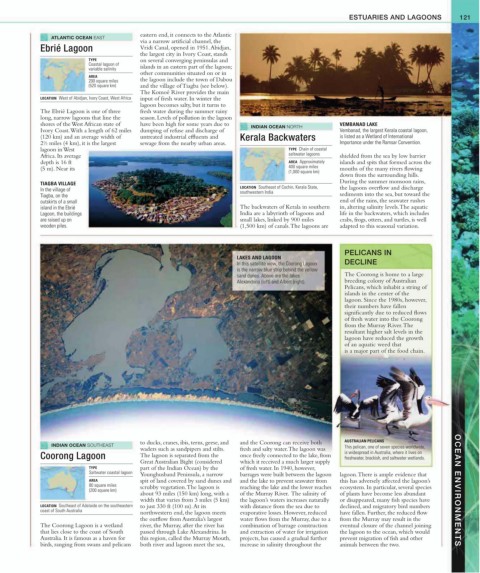
ESTUARIES AND LAGOONS            121


                ATLANTIC OCEAN EAST        eastern end, it connects to the Atlantic
                                           via a narrow artificial channel, the
             Ebrié Lagoon                  Vridi Canal, opened in 1951. Abidjan,
                                           the largest city in Ivory Coast, stands
                           TYPE            on several converging peninsulas and
                           Coastal lagoon of
                           variable salinity  islands in an eastern part of the lagoon;
                                           other communities situated on or in
                           AREA
                           200 square miles   the lagoon include the town of Dabou
                           (520 square km)   and the village of Tiagba (see below).
                                           The Komoé River provides the main
             LOCATION  West of Abidjan, Ivory Coast, West Africa   input of fresh water. In winter the
                                           lagoon becomes salty, but it turns to
             The Ebrié Lagoon is one of three   fresh water during the summer rainy
             long, narrow lagoons that line the   season. Levels of pollution in the lagoon
             shores of the West African state of   have been high for some years due to   INDIAN OCEAN NORTH  VEMBANAD LAKE
             Ivory Coast. With a length of 62 miles   dumping of refuse and discharge of              Vembanad, the largest Kerala coastal lagoon,
             (120 km) and an average width of   untreated industrial effluents and   Kerala Backwaters  is listed as a Wetland of International
             2/2 miles (4 km), it is the largest   sewage from the nearby urban areas.                Importance under the Ramsar Convention.
              1
             lagoon in West                                                            TYPE  Chain of coastal
             Africa. Its average                                                       saltwater lagoons  shielded from the sea by low barrier
             depth is 16 ft                                                            AREA  Approximately    islands and spits that formed across the
             (5 m). Near its                                                           400 square miles   mouths of the many rivers flowing
                                                                                       (1,000 square km)
                                                                                                      down from the surrounding hills.
                                                                                                      During the summer monsoon rains,
             TIAGBA VILLAGE
             In the village of                                          LOCATION  Southeast of Cochin, Kerala State,   the lagoons overflow and discharge
                                                                        southwestern India
             Tiagba, on the                                                                           sediments into the sea, but toward the
             outskirts of a small                                                                     end of the rains, the seawater rushes
             island in the Ebrié                                        The backwaters of Kerala in southern   in, altering salinity levels. The aquatic
             Lagoon, the buildings                                      India are a labyrinth of lagoons and   life in the backwaters, which includes
             are raised up on                                           small lakes, linked by 900 miles   crabs, frogs, otters, and turtles, is well
             wooden piles.                                              (1,500 km) of canals. The lagoons are   adapted to this seasonal variation.

                                                                                                        PELICANS IN
                                                                        LAKES AND LAGOON
                                                                        In this satellite view, the Coorong Lagoon   DECLINE
                                                                        is the narrow blue strip behind the yellow
                                                                        sand dunes. Above are the lakes   The Coorong is home to a large
                                                                        Alexandrina (left) and Albert (right).  breeding colony of Australian
                                                                                                        Pelicans, which inhabit a string of
                                                                                                        islands in the center of the
                                                                                                        lagoon. Since the 1980s, however,
                                                                                                        their numbers have fallen
                                                                                                        significantly due to reduced flows
                                                                                                        of fresh water into the Coorong
                                                                                                        from the Murray River. The
                                                                                                        resultant higher salt levels in the
                                                                                                        lagoon have reduced the growth
                                                                                                        of an aquatic weed that
                                                                                                        is a major part of the food chain.


                INDIAN OCEAN SOUTHEAST     to ducks, cranes, ibis, terns, geese, and   and the Coorong can receive both   AUSTRALIAN PELICANS
                                                                                                        This pelican, one of seven species worldwide,
                                           waders such as sandpipers and stilts.   fresh and salty water. The lagoon was   is widespread in Australia, where it lives on
             Coorong Lagoon                The lagoon is separated from the    once freely connected to the lake, from   freshwater, brackish, and saltwater wetlands.
                                           Great Australian Bight (considered   which it received a much larger supply
                           TYPE            part of the Indian Ocean) by the   of fresh water. In 1940, however,
                           Saltwater coastal lagoon  Younghusband Peninsula, a narrow   barrages were built between the lagoon   lagoon. There is ample evidence that
                           AREA            spit of land covered by sand dunes and   and the lake to prevent seawater from   this has adversely affected the lagoon’s
                           80 square miles    scrubby vegetation. The lagoon is   reaching the lake and the lower reaches   ecosystem. In particular, several species
                           (200 square km)                                                                                               OCEAN ENVIRONMENTS
                                           about 93 miles (150 km) long, with a   of the Murray River.  The salinity of   of plants have become less abundant
                                           width that varies from 3 miles (5 km)   the lagoon’s waters increases naturally   or disappeared, many fish species have
             LOCATION  Southeast of Adelaide on the southeastern   to just 330 ft (100 m). At its   with distance from the sea due to   declined, and migratory bird numbers
             coast of South Australia      northwestern end, the lagoon meets   evaporative losses. However, reduced   have fallen. Further, the reduced flow
                                           the outflow from Australia’s largest   water flows from the Murray, due to a   from the Murray may result in the
             The Coorong Lagoon is a wetland   river, the Murray, after the river has   combination of barrage construction   eventual closure of the channel joining
             that lies close to the coast of South   passed through Lake Alexandrina. In   and extraction of water for irrigation   the lagoon to the ocean, which would
             Australia. It is famous as a haven for   this region, called the Murray Mouth,   projects, has caused a gradual further   prevent migration of fish and other
             birds, ranging from swans and pelicans   both river and lagoon meet the sea,   increase in salinity throughout the   animals between the two.

