


Page 575 - First Aid for the USMLE Step 1 2020, Thirtieth edition [MedicalBooksVN.com]_Neat
P. 575
Neurology aNd Special SeNSeS ` neurology—PAthology Neurology aNd Special SeNSeS ` neurology—PAthology SecTioN iii 531
Poliomyelitis Caused by poliovirus (fecal-oral transmission). Replicates in oropharynx and small intestine before
spreading via bloodstream to CNS. Infection causes destruction of cells in anterior horn of spinal
cord (LMN death).
Signs of LMN lesion: asymmetric weakness (vs symmetric weakness in spinal muscular atrophy),
hypotonia, flaccid paralysis, fasciculations, hyporeflexia, muscle atrophy. Respiratory muscle
involvement leads to respiratory failure. Signs of infection: malaise, headache, fever, nausea, etc.
CSF shows WBCs (lymphocytic pleocytosis) and slight of protein (with no change in CSF
glucose). Virus recovered from stool or throat.
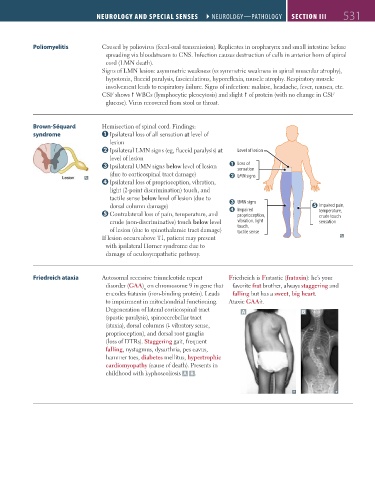
Brown-Séquard Hemisection of spinal cord. Findings:
syndrome Ipsilateral loss of all sensation at level of
lesion
Ipsilateral LMN signs (eg, flaccid paralysis) at Level of lesion
level of lesion
Ipsilateral UMN signs below level of lesion Loss of
sensation
(due to corticospinal tract damage) LMN signs
Ipsilateral loss of proprioception, vibration,
light (2-point discrimination) touch, and
tactile sense below level of lesion (due to
dorsal column damage) UMN signs Impaired pain,
Contralateral loss of pain, temperature, and Impaired temperature,
proprioception,
crude touch
crude (non-discriminative) touch below level vibration, light sensation
of lesion (due to spinothalamic tract damage) touch,
tactile sense
If lesion occurs above T1, patient may present
with ipsilateral Horner syndrome due to
damage of oculosympathetic pathway.
Friedreich ataxia Autosomal recessive trinucleotide repeat Friedreich is Fratastic (frataxin): he’s your
disorder (GAA) on chromosome 9 in gene that favorite frat brother, always staggering and
n
encodes frataxin (iron-binding protein). Leads falling but has a sweet, big heart.
to impairment in mitochondrial functioning. Ataxic GAAit.
Degeneration of lateral corticospinal tract A B
(spastic paralysis), spinocerebellar tract
(ataxia), dorsal columns ( vibratory sense,
proprioception), and dorsal root ganglia
(loss of DTRs). Staggering gait, frequent
falling, nystagmus, dysarthria, pes cavus,
hammer toes, diabetes mellitus, hypertrophic
cardiomyopathy (cause of death). Presents in
childhood with kyphoscoliosis A B .
FAS1_2019_12-Neurol.indd 531 11/8/19 7:39 AM

