


Page 576 - First Aid for the USMLE Step 1 2020, Thirtieth edition [MedicalBooksVN.com]_Neat
P. 576
532        SecTioN iii    Neurology aNd Special SeNSeS  ` neurology—PAthology                                                                           Neurology aNd Special SeNSeS  ` neurology—otology


               Common cranial nerve lesions
                CN V motor lesion    Jaw deviates toward side of lesion due to unopposed force from the opposite pterygoid muscle.
                CN X lesion          Uvula deviates away from side of lesion. Weak side collapses and uvula points away.
                CN XI lesion         Weakness turning head to contralateral side of lesion (SCM). Shoulder droop on side of lesion
                                       (trapezius).
                                     The left SCM contracts to help turn the head to the right.
                CN XII lesion        LMN lesion. Tongue deviates toward side of lesion (“lick your wounds”) due to weakened tongue
                                       muscles on affected side.


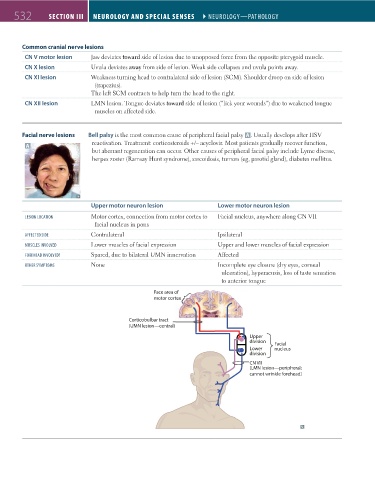
               Facial nerve lesions  Bell palsy is the most common cause of peripheral facial palsy  A . Usually develops after HSV
                                      reactivation. Treatment: corticosteroids +/– acyclovir. Most patients gradually recover function,
                A
                                      but aberrant regeneration can occur. Other causes of peripheral facial palsy include Lyme disease,
                                      herpes zoster (Ramsay Hunt syndrome), sarcoidosis, tumors (eg, parotid gland), diabetes mellitus.


                                     Upper motor neuron lesion                 Lower motor neuron lesion

                lesion loCAtion      Motor cortex, connection from motor cortex to   Facial nucleus, anywhere along CN VII
                                       facial nucleus in pons
                AFFeCted side        Contralateral                             Ipsilateral

                musCles inVolVed     Lower muscles of facial expression        Upper and lower muscles of facial expression
                ForeheAd inVolVed?   Spared, due to bilateral UMN innervation  Affected
                other symPtoms       None                                      Incomplete eye closure (dry eyes, corneal
                                                                                ulceration), hyperacusis, loss of taste sensation
                                                                                to anterior tongue

                                                          Face area of
                                                          motor cortex


                                                  Corticobulbar tract
                                                  (UMN lesion—central)
                                                                                         Upper
                                                                                         division  Facial
                                                                                         Lower   nucleus
                                                                                         division
                                                                                         CN VII
                                                                                         (LMN lesion—peripheral;
                                                                                         cannot wrinkle forehead)


          FAS1_2019_12-Neurol.indd   532                                                                                11/8/19   7:39 AM

